Raeren Stoneware Armorial Schnelle


Raeren Stoneware Schnelle dated 1580 with Arms of Johann Friedrich Herzog von Pommern-Stettin (Johann Friedrich, Duke of Pomerania-Stettin)
Provenance: Collection Leopold Blumka New York
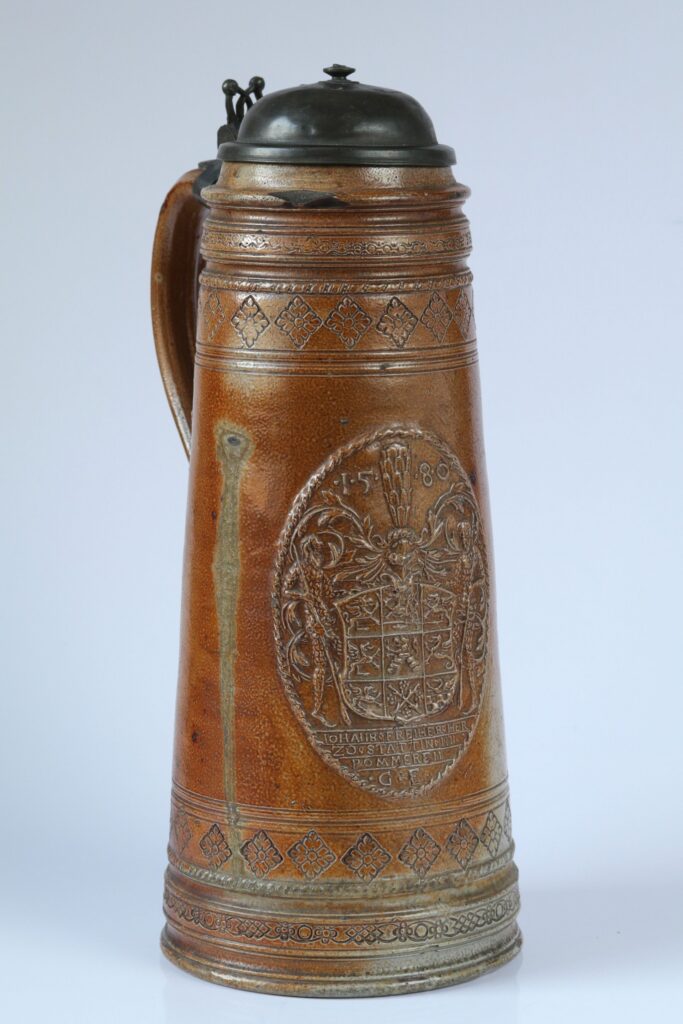
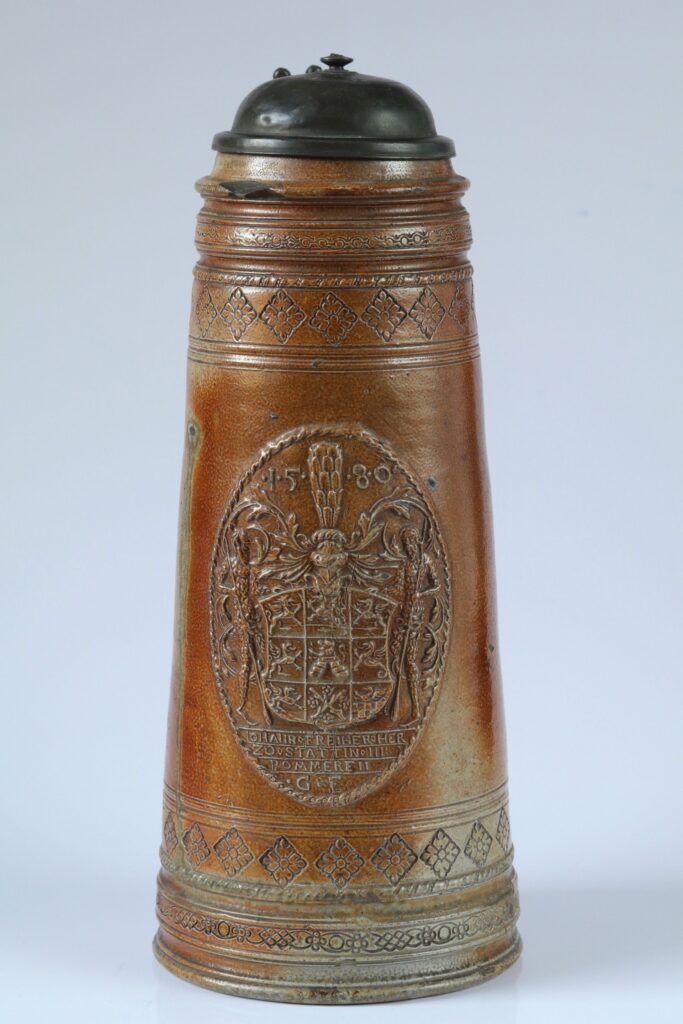
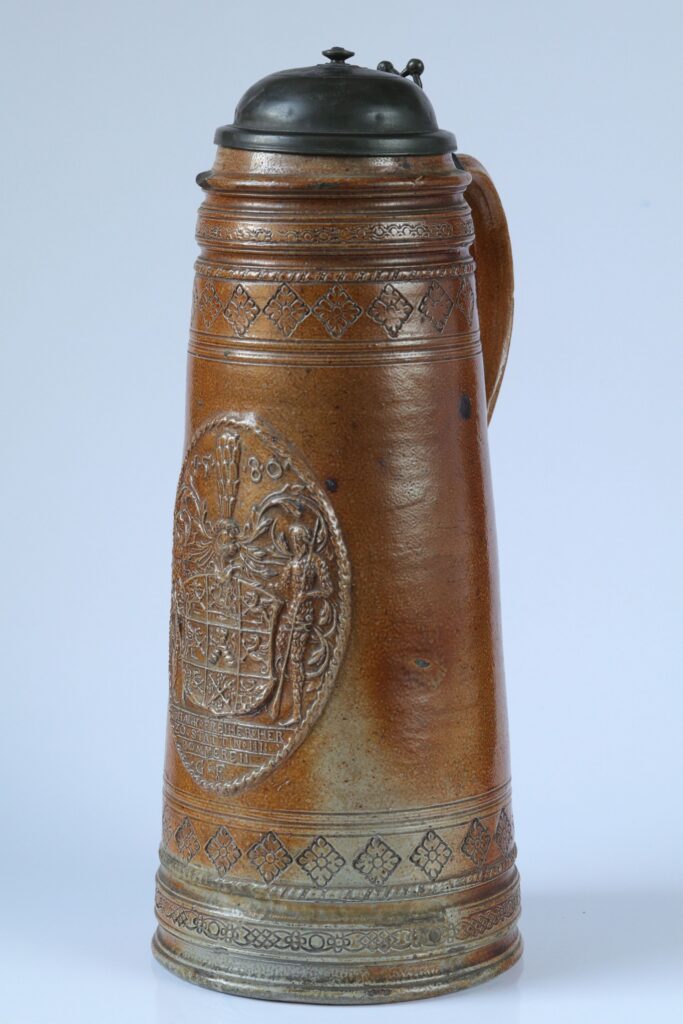
Inscription: JOHANS FREIHER HER / ZO STATTIN IN / POMMEREN.
The ducal coat of arms was also reproduced on Raeren stoneware objects such as Schnellen (flagon). Although the armorial application is dated 1580, it displays the earlier version of the coat of arms. The shield bears nine fields, and the wild men are depicted without helmets, suggesting that the armorial template dates to before 1551. The inscription below reads: JOHANS FREIHER HER / ZO STATTIN IN / POM-MEREN. The initials GE also appear, attributed to Gilles Emonts, who was active from 1576 to 1624.
See Source: Marcin A. Majewski
Greifen in der Keramik. Die Herzöge von Pommern – ihre Abbilder und Heraldik Download des Artikels hier:
https://www.academia.edu/38403651/Greifen_in_der_Keramik_Die_Herz%C3%B6ge_von_Pommern_ihre_Abbilder_und_Heraldik
2018, Ceramics between Advertising, Propaganda and Practical Use. Papers from the 50th International Symposium on Ceramics Research in Innsbruck 2017, edited by H. Stadler, L. Obojes, and M. Roehmer, (Nearchos 23), Innsbruck/2018, Keramik zwischen Werbung, Propaganda und praktischem Gebrauch. Beiträge vom 50. Internationalen Symposium Keramikforschung in Innsbruck 2017, hg. von H. Stadler, L. Obojes, M. Roehmer, (Nearchos 23), Innsbruck
Reference Object: Raerener Töpfereimuseum:
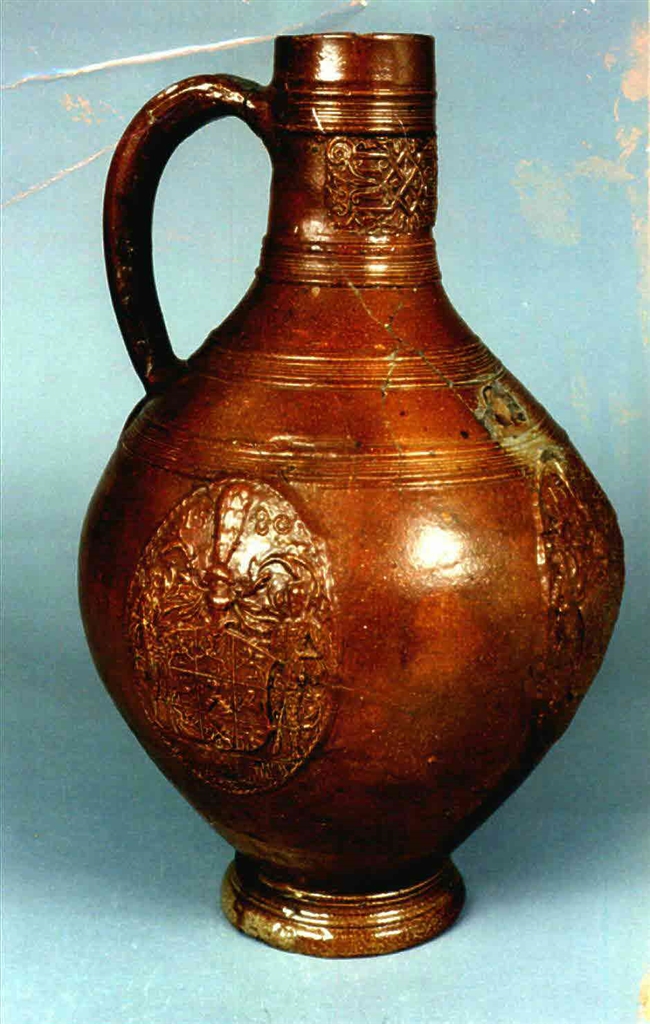

Refrence Object Victoria + Albert Museum, London
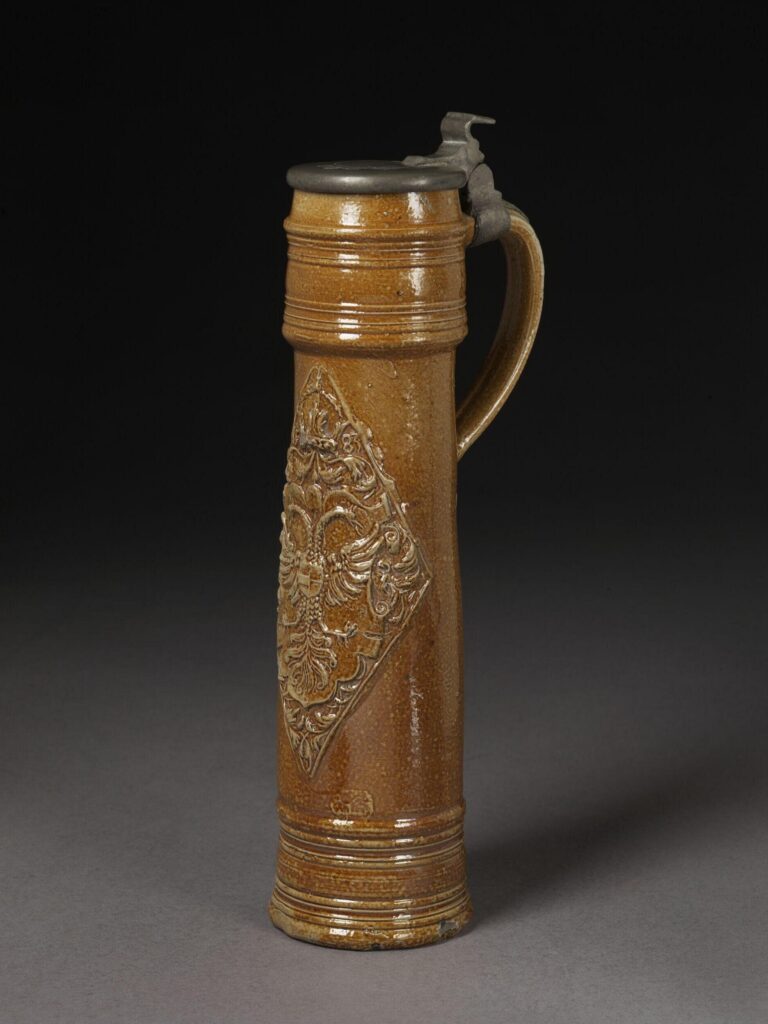
Tankard depicting the arms of the Holy Roman Empire, Workshop of Jan Emens Mennicken, Raeren, Germany, dated 1583, stoneware with applied moulded decoration
https://collections.vam.ac.uk/item/O159820/tankard-mennicken-jan-emens
The Ducal Seal of Johann Friedrich of Pomerania:
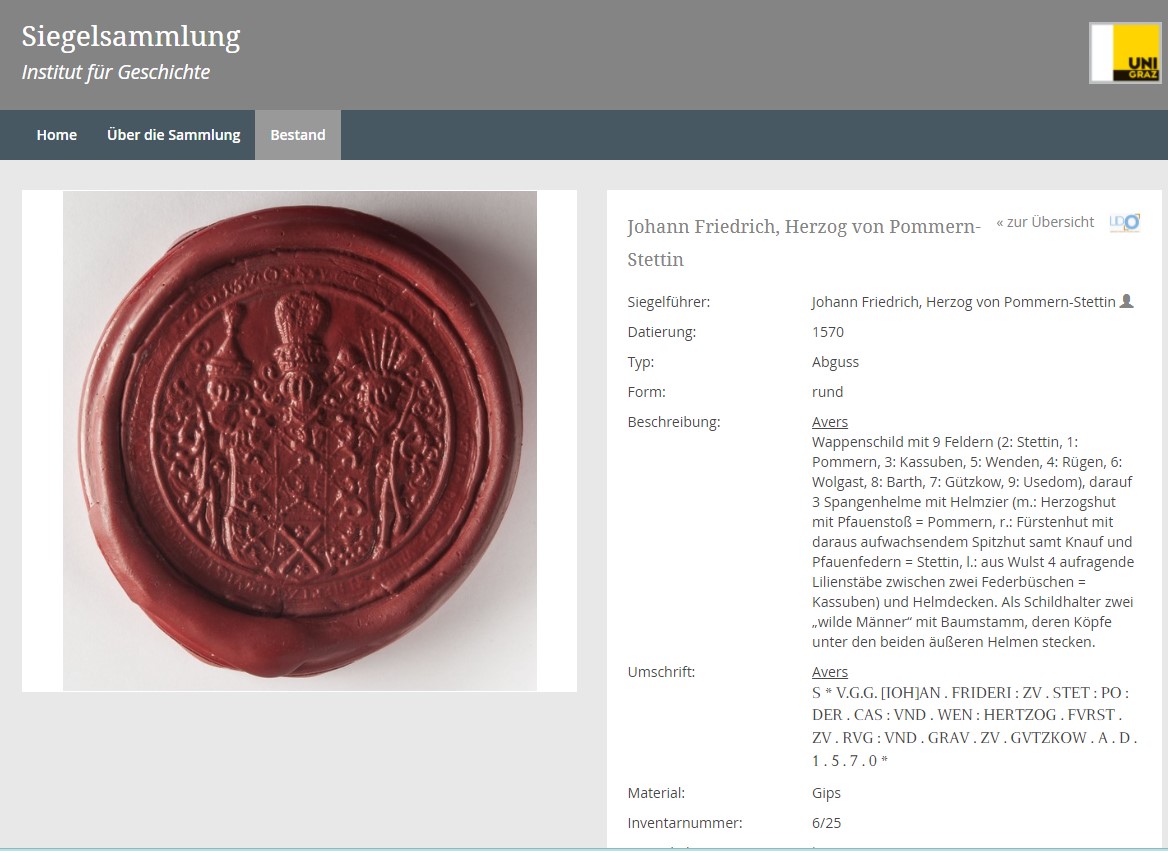
Johann Friedrich, Duke of Pomerania-Stettin:
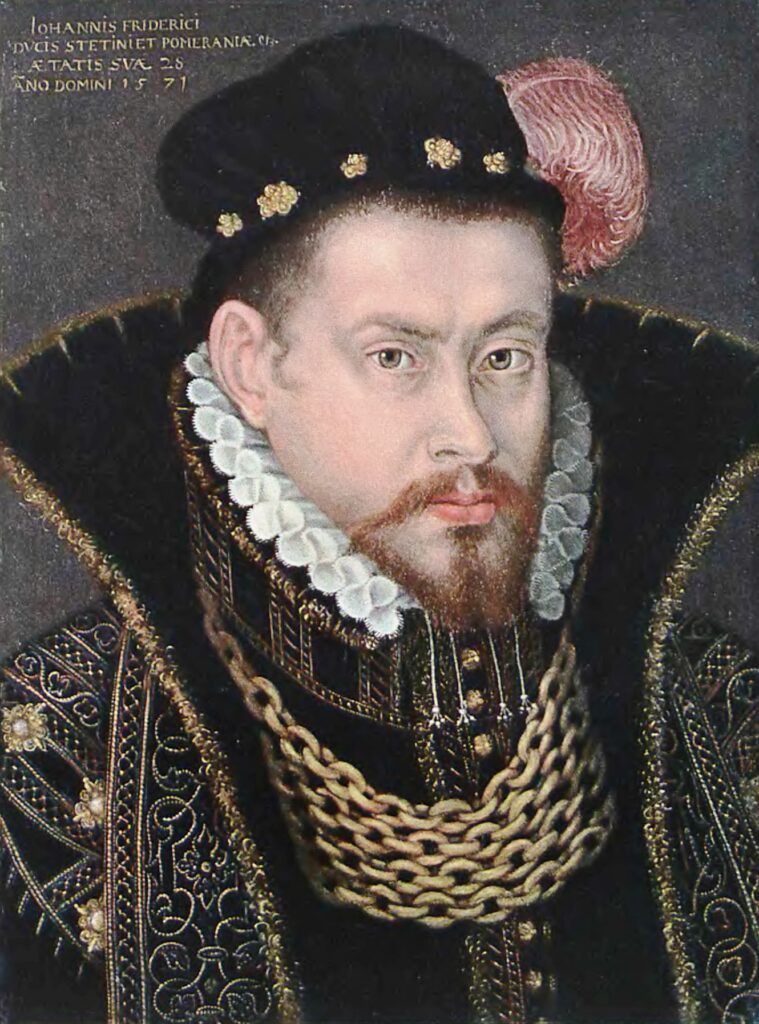
Johann Friedrich, Ölgemälde von Giovanni Battista Perini, 1577
https://commons.wikimedia.org/w/index.php?curid=24124034
* 27. August 1542 in Wolgast; † 9. Februar 1600 in Wolgast
Source translated from German: https://kulturstiftung.org/biographien/johann-friedrich-2
Pomerania was divided when Duke Johann Friedrich assumed rule of Pomerania-Wolgast following his father’s death in 1560. He was born in Wolgast Castle, the eldest son of Duke Philipp I and his consort Maria of the Saxon ruling house. Duke Philipp devoted considerable care to the education of his eight surviving children, consulting distinguished men such as Bugenhagen and Melanchthon and having his three eldest sons study at the University of Greifswald, the Pomeranian university founded in 1456. As early as 1556, Johann Friedrich was appointed the first secular Bishop of Cammin, an office he held until 1574 and which thereafter remained in the possession of members of the ducal house. When his great-uncle Barnim IX renounced rule of Pomerania-Stettin in 1569 without male heirs, Duke Johann Friedrich, now 27 years old, assumed control of this territory, initially together with his brother Barnim.
Author: Friedrich Birkholz
Literature: Martin Wehrmann: Geschichte der Stadt Stettin, Stettin: Leon Sauniers Buchhandlung 1911. – Chronik der Stadt Stettin 1849, edited according to documents and the most reliable historical sources by Fr. Thiede, Stettin: Vlg. von Ferdinand Müller 1849. – Martin Wehrmann: Geschichte von Pommern, vol. 2, Gotha: Perthes 1921.
Literature
German stoneware, 1200-1900 : archaeology and cultural history : containing a guide to the collections of the British Museum, Victoria & Albert Museum, and Museum of London
by Gaimster, David R. M
Online access at Internet archive with this link:
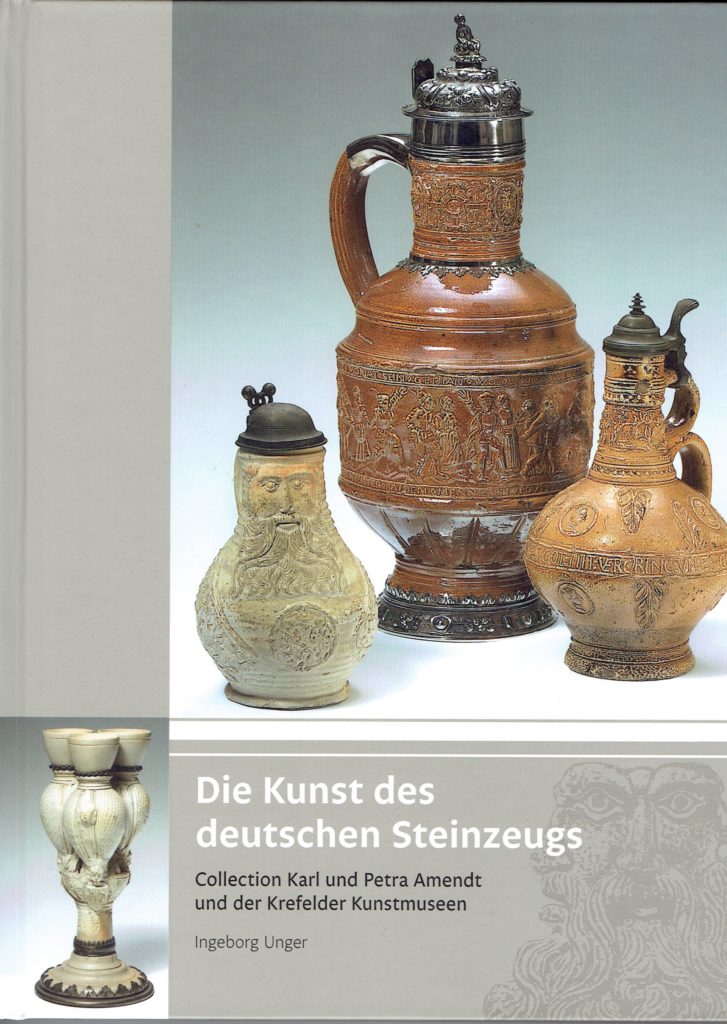
Unger, I. (2013). Die Kunst des deutschen Steinzeugs. Collection Karl und Petra Amendt und der Krefelder Kunstmuseen (Krefeld 2013).


