Dippoldiswalde Hunting Jug dated 1688


Dippoldiswalde Stoneware formerly attributed to Annaberg
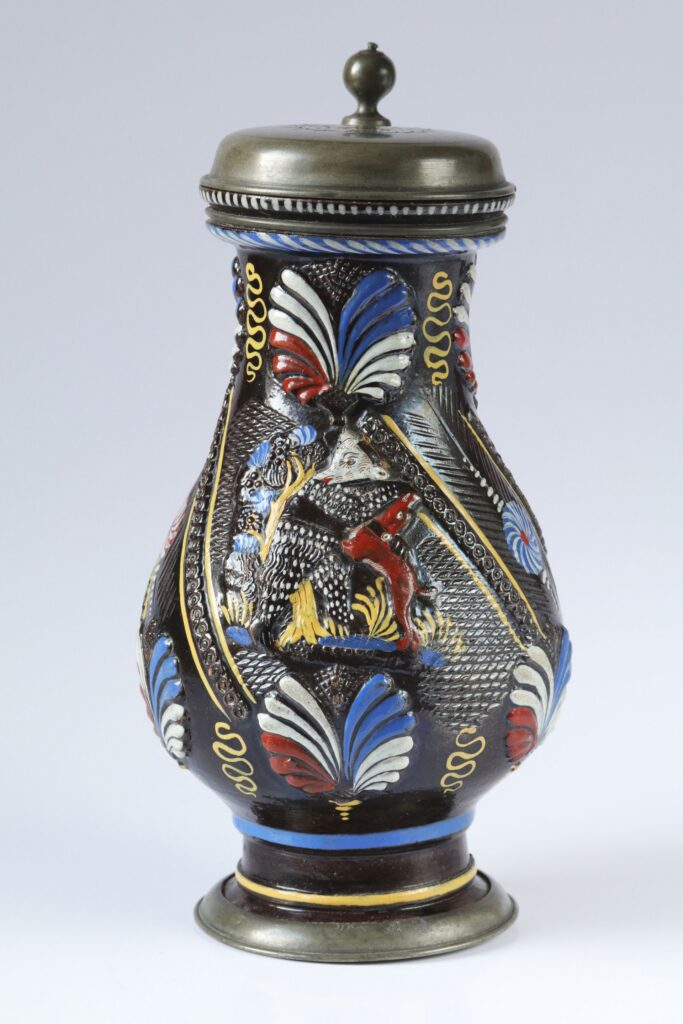
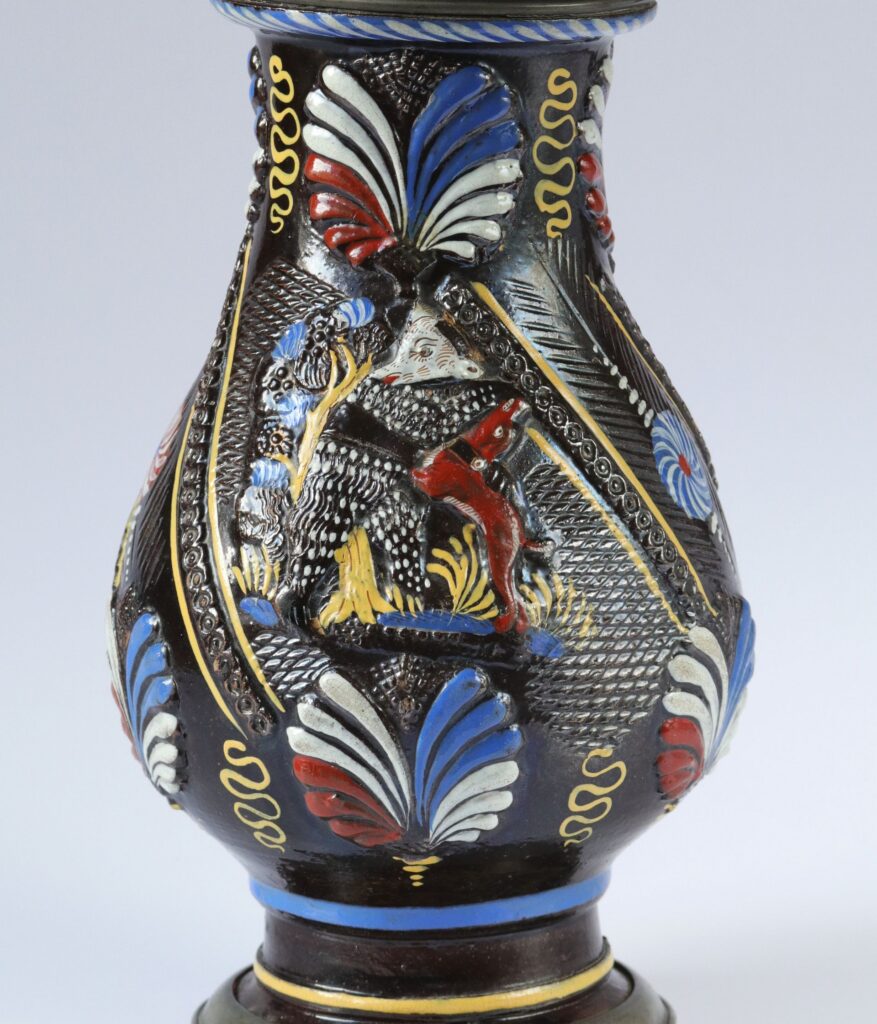
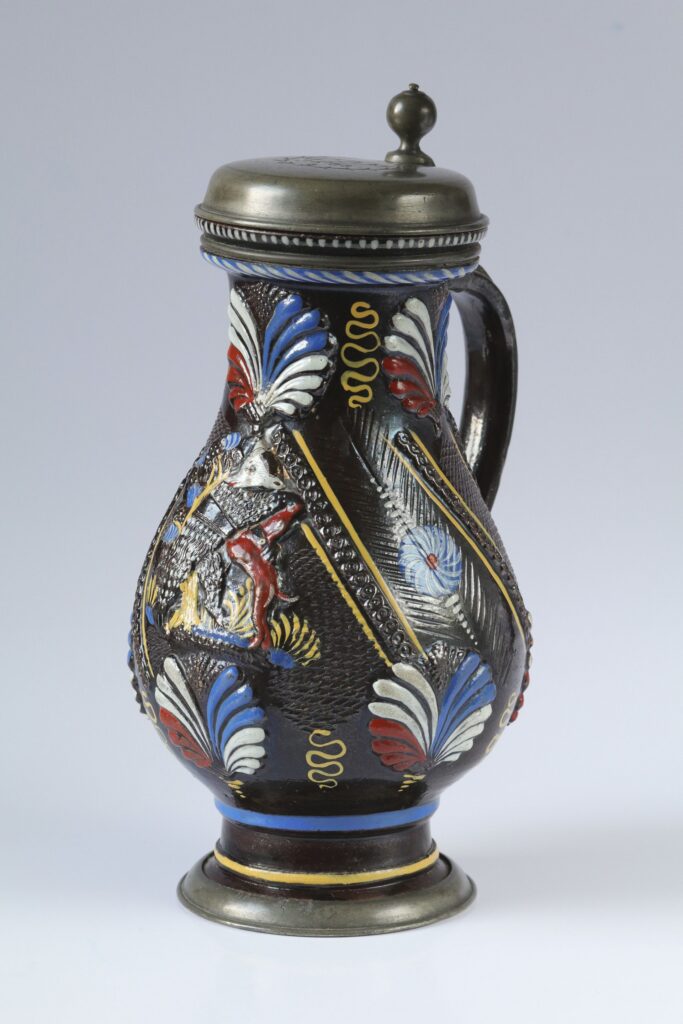
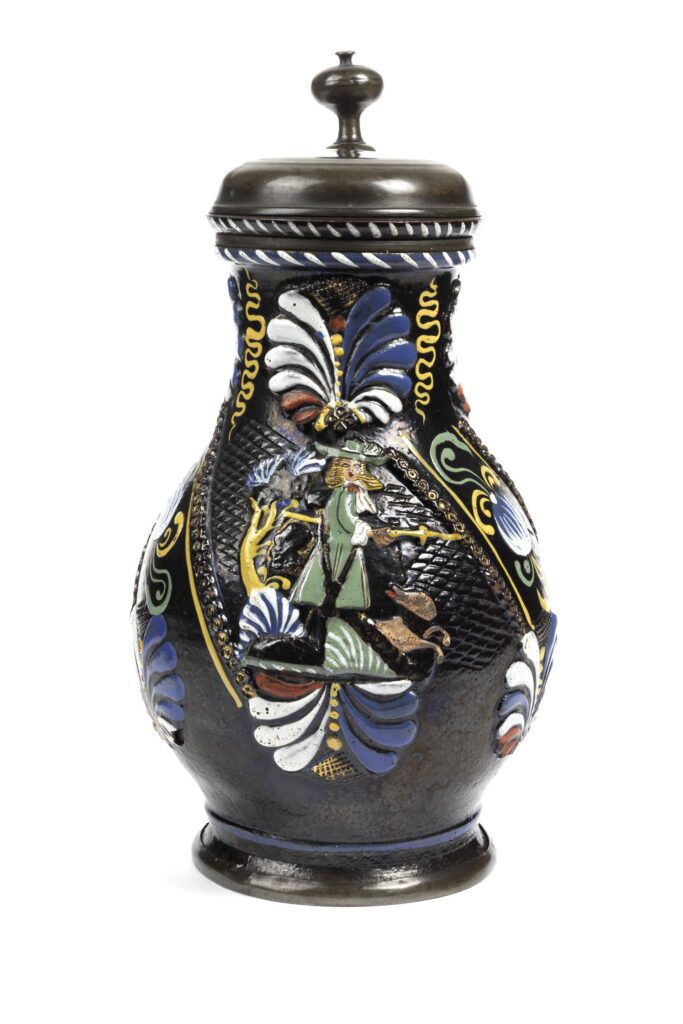
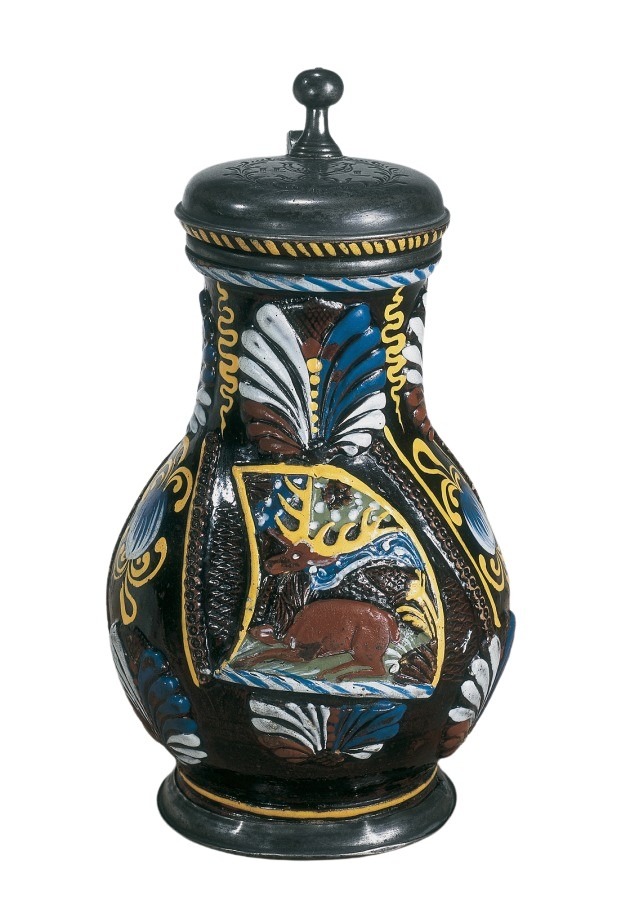
The enamelled and gilded decoration on this pear-shaped jug is enhanced by a very dark brown slip that was used to cover the stoneware beneath. The applied relief shows a a bear and hound framed by palmettos alternating with diagonal bands.
Attribution: Annaberg | Dippoldiswalde
Speculations on attributions of Dippoldiswalde stoneware since the middle of 19th century have been manifold. Ranging from mere speculations to serious research based on pewter marks and coat of arms to determin a place or origin. At the middle of 20th century Annaberg was most probable as the location of the productions of these ceramic objects. A very good description of the development of the attribution of Dippoldiswalde stoneware since the middle of the 19th century can be obtained by the standard reference Horschik Steinzeug p 217 ff (Horschik, Josef. Steinzeug: 15.-19. Jh.; von Bürgel bis Muskau. Ebeling, 1981.)
So I do not want to go into this any further, as these longstanding discussions came to an end at the turn of the century with excavations that have been taking place in the Dippoldiswalde area and produced finds of “Annaberg type” molds and fragments. As a result the state of research as of today is that Dippoldiswalde is the origin of these stoneware objects formerly attributed to Annaberg.
Characteristics of Dippoldiswalde
The heyday of craftsmanship of Dippoldiswalde Stoneware was the second half of the 17th century.
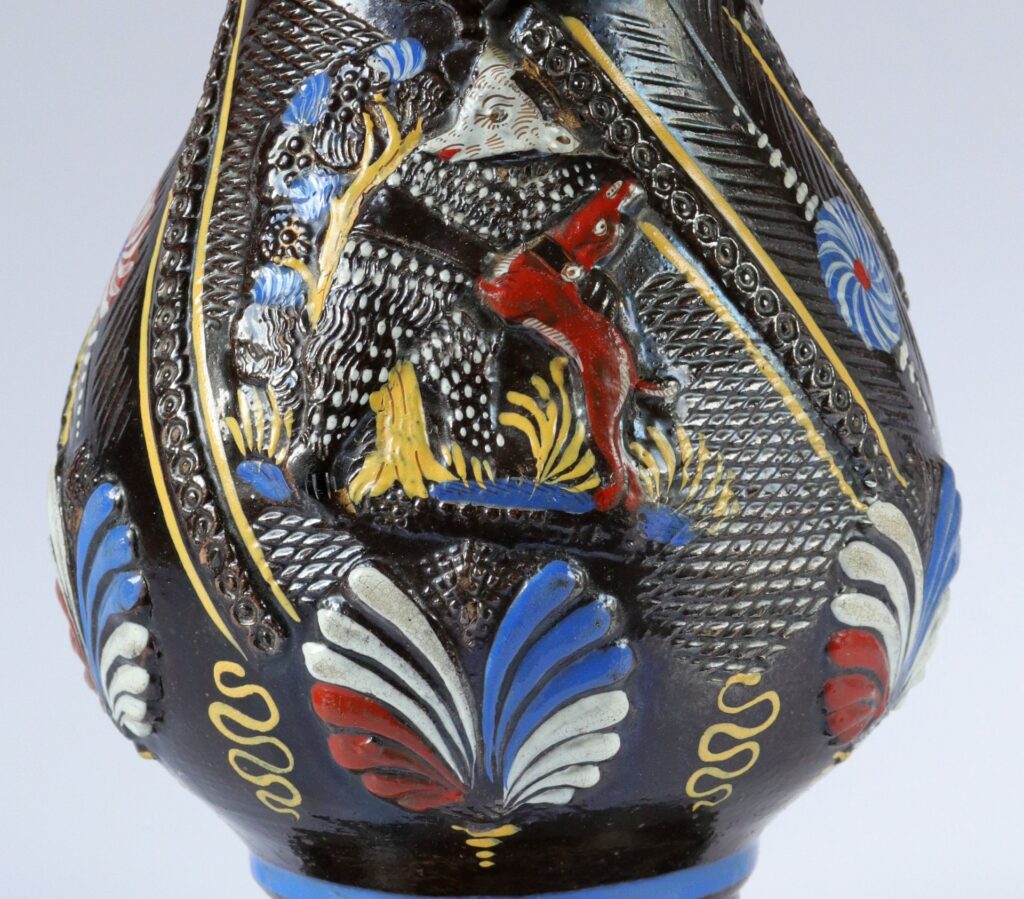
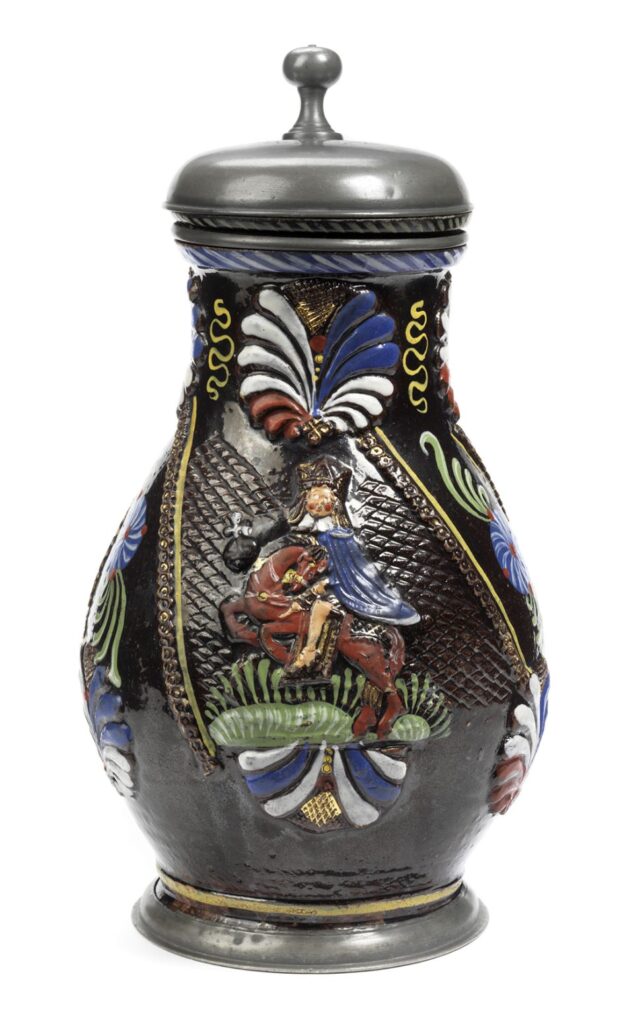
Characteristic of Dippoldiswalde that form a unique style are first of all the very darkbrown slip with impressed scale pattern as a contrasting foundation for the
applied relief decoration with
enamel painting mainly in white, red, yellow, blue partly guilded. Further decorative ornaments were palmettos or pomgranates alternating with diagonal bands
to design especially the pear-shaped jugs.
Repertoire of Motifs
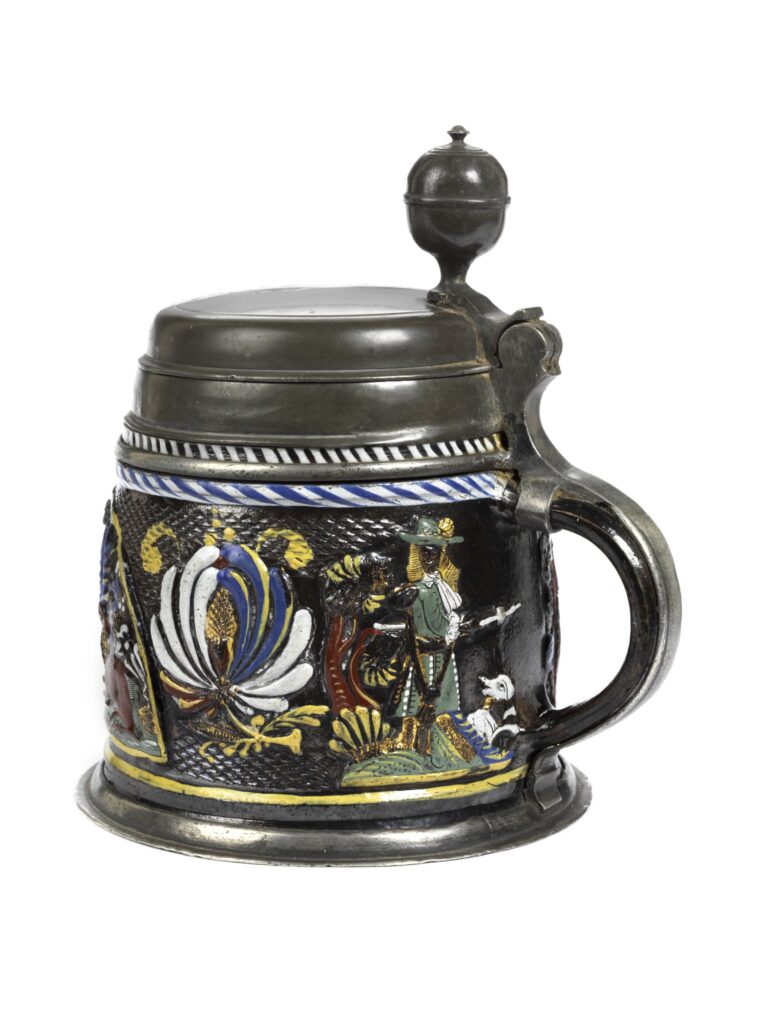
The potters had a substantial stock of moulds at their possession to decorate the central relief. Very popular were Elector and Electress mainly as half bust or hunting scenes. As follows a more or less complete overview by Josef Horschik.
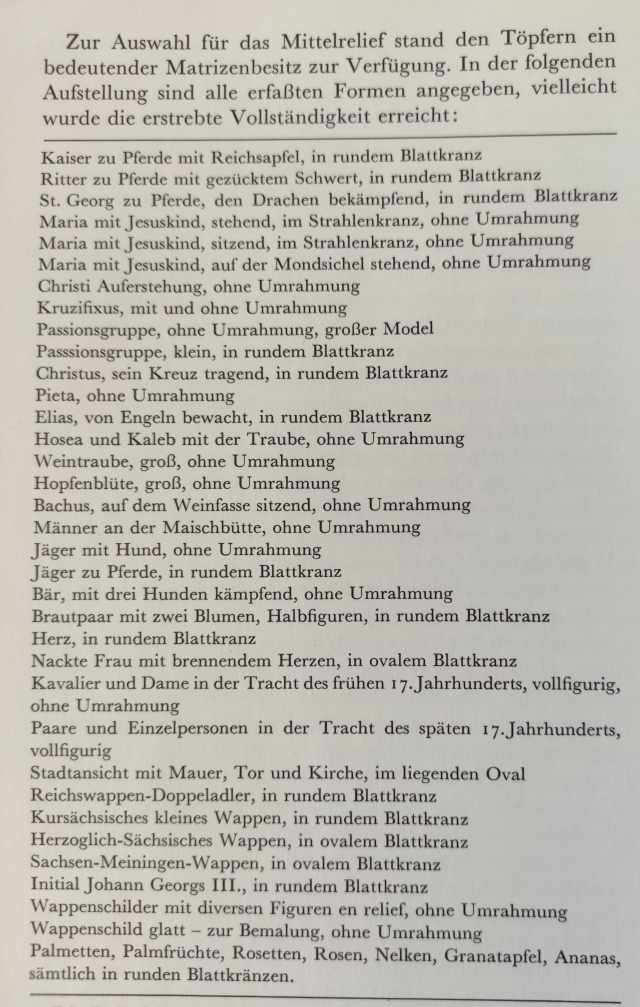
Table of moulds for the central relief:
Topics were religious (e.g. Christ or Mary with Child Jesus) secular (e.g. Emperor or Elector), hunting scenes, coat of arms, brewing and viticulture, marriage and chivalrous couples
Josef Horschik, Steinzeug: 15. bis 19. Jahrhundert; von Bűrgel bis Muskau, 1978
p 230.
Museum Reference Object – Topic – Heylshof Museum, Worms
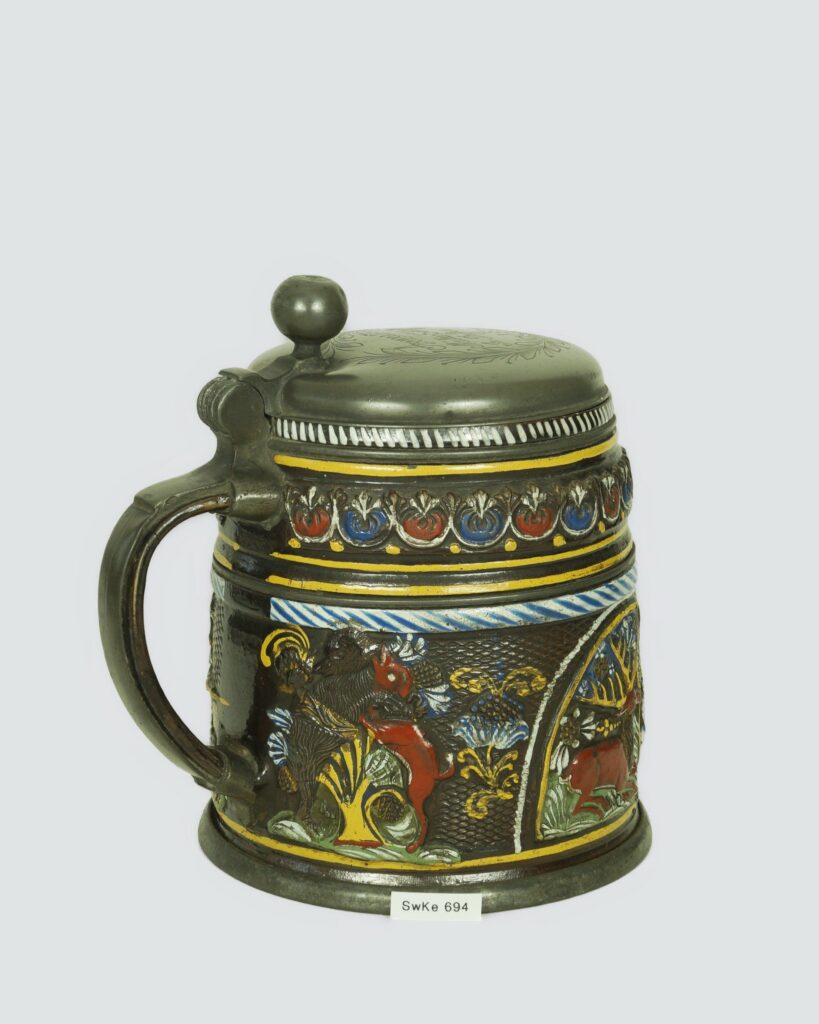
Jagdkrug mit graviertem Zinndeckel
Sachsen ca. 1680
Auflage der Vorderseite: Doppelbildnis, Fürst und Fürstin, daneben gelbe Blattstauden; auf der Rückseite Bärenjagd, links und rechts vom Henkel verteilt; Rand mit Palmettenfries;
Deckel und Fußrand aus Zinn; auf dem Deckel Stempel (innen) und gravierte Inschrift (außen):
„Arnholdt Müller Schlosser in Dresden 1689“.
Source: © Museum Heylshof & U. Felden
https://nat.museum-digital.de/object/1210688
Reference Objects – Collection Peter Vogt Munich
Literature
Josef Horschik, Steinzeug: 15. bis 19. Jahrhundert; von Bűrgel bis Muskau, 1978
Seiten 217 ff.
German stoneware, 1200-1900 : archaeology and cultural history : containing a guide to the collections of the British Museum, Victoria & Albert Museum, and Museum of London
by Gaimster, David R. M
Online access at Internet archive with this link:
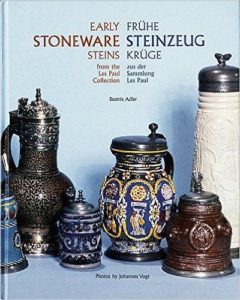
Adler, B. (2005). Early stoneware steins from the Les Paul Collection: A survey of all German stoneware centers from 1500 to 1850. Beatrix Adler.
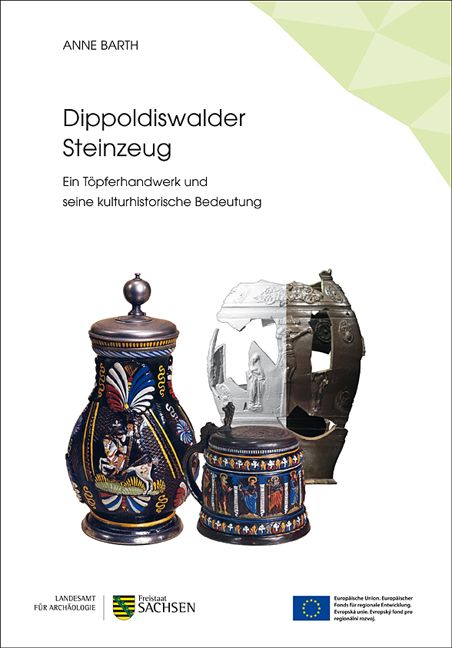
„Anne Barth: Dippoldiswalder Steinzeug. Ein Töpferhandwerk und seine kulturhistorische Bedeutung.“ 2018
Landesamt für Archäologie Sachsen (Verlag).
https://journals.ub.uni-heidelberg.de/index.php/mitt-dgamn/article/view/77935


