Evangelists‘ Glass Beaker ca. 1670


Enamelled Glass and Protestant Devotion in late 17th century
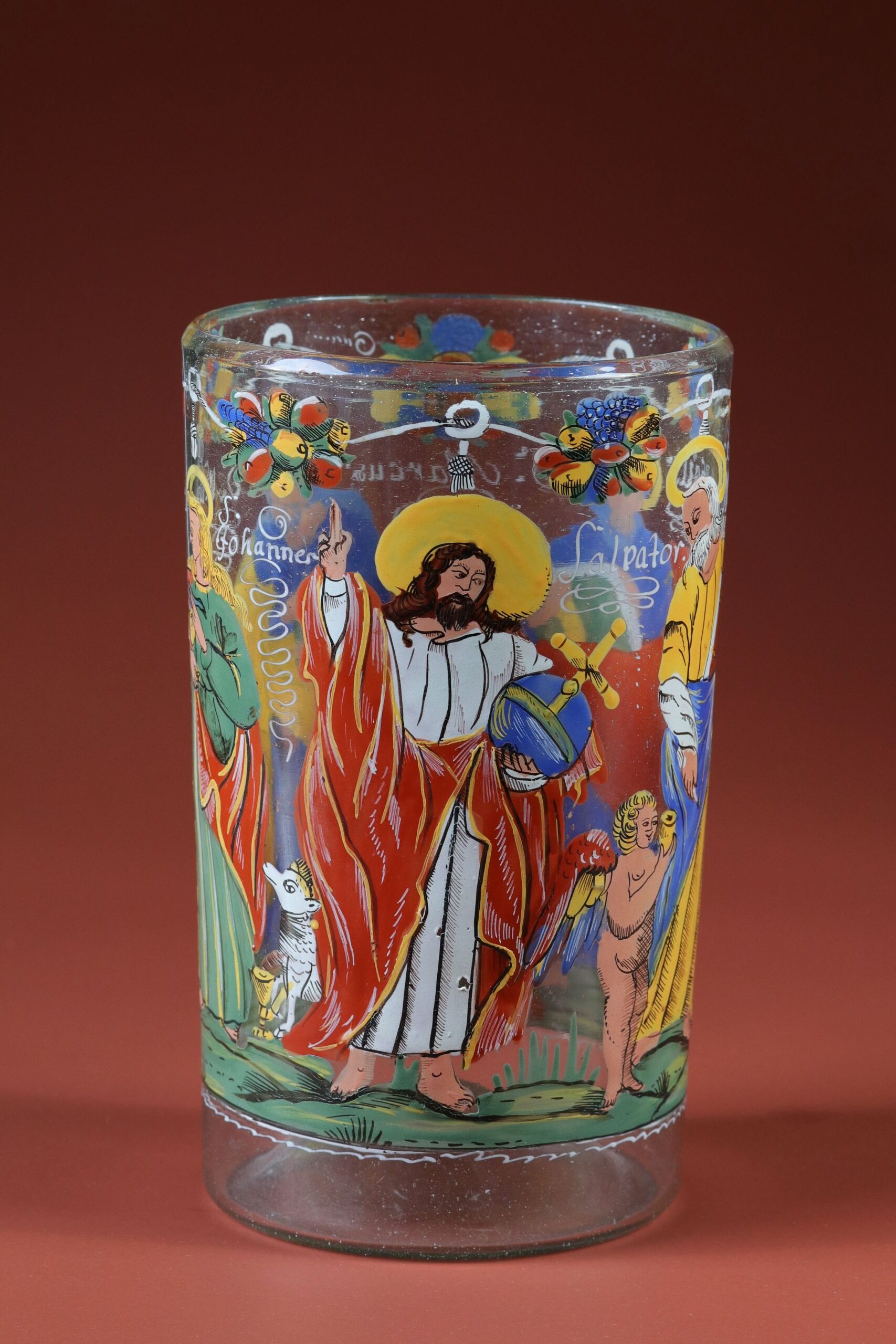
Abgebildet in: Bemalte Gläser von Franz Carl Lipp, 1974, Farbtafel VII
Very rare Evangelisten Humpen (Evangelists‘ beaker) circa 1670, featuring polychrome enamel decoration. The object displays the four Evangelists with their traditional symbolic attributes and is an example of 17th century glasses embellished with Biblical themes.
Enamelled Glass – 16th to 18th Centuries
The refinement of glass through enamelling was already practised in the late sixteenth century. The technique was highly demanding. Enamel colours consist of low-melting, finely ground, colourless glass to which colouring metal oxides or salts are added. A distinction is made between transparent and opaque colours. These are applied with a brush as a glass flux—that is, after heating—to the fully formed vessel. Subsequently, the colours must be fired and thus made permanent. At temperatures of 800°C to 850°C, the glass layer fuses with the glass surface. Until the 1670s, the vessel was held a second time in the fire or over the melt in the heat of the furnace opening. Considerable experience and sensitivity were required for this working step, as there was a risk of deformation of the glass body under renewed exposure to heat. Thereafter, with the introduction of the enamelling kiln, also known as a muffle furnace, the enamel could be fused at temperatures around 500°C.
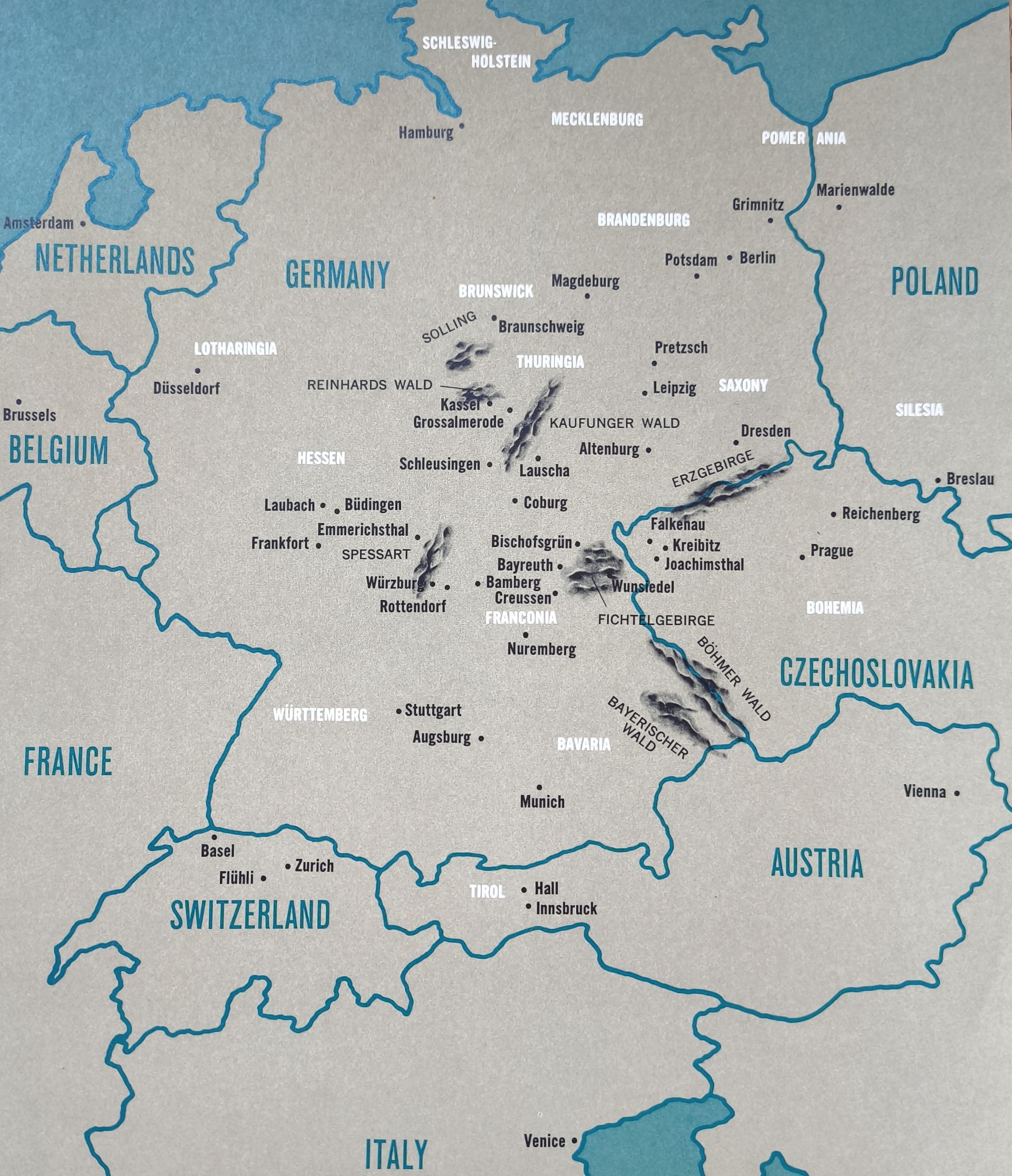
Locations of glass production in Europe
German enameled glass
The Edwin J. Beinecke collection and
related pieces
Axel von Saldern
Corning Museum of Glass, 1965
Schematic map showing principal locations
Iconography of the Evangelists
The Evangelists‘ symbols derive from the vision in Ezekiel 1:5-10 and Revelation 4:6-8.
In post-Reformation Germany, such religious imagery could affirm Lutheran Protestant faith.
- Matthew: Angel/winged man (emphasizing Christ’s human incarnation)
- John: Eagle (signifying divine nature and spiritual heights of his Gospel)
- Mark: Winged lion (representing resurrection and Christ’s royal dignity)
- Luke: Winged ox/calf (symbolizing sacrifice and Christ’s priestly office)
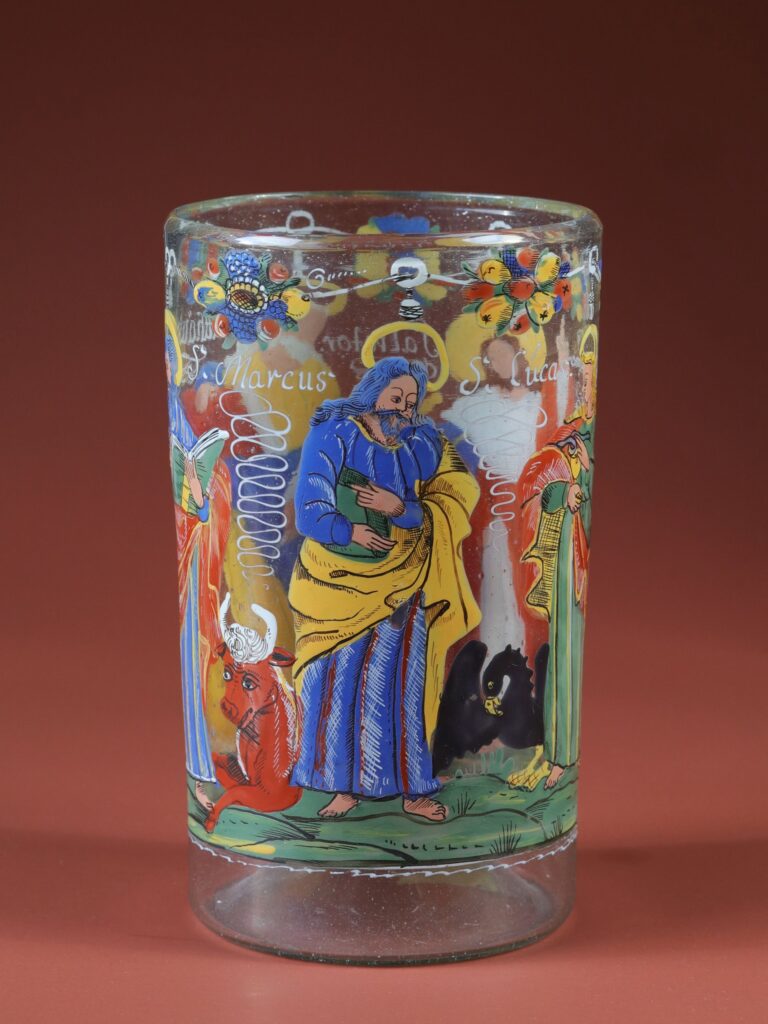
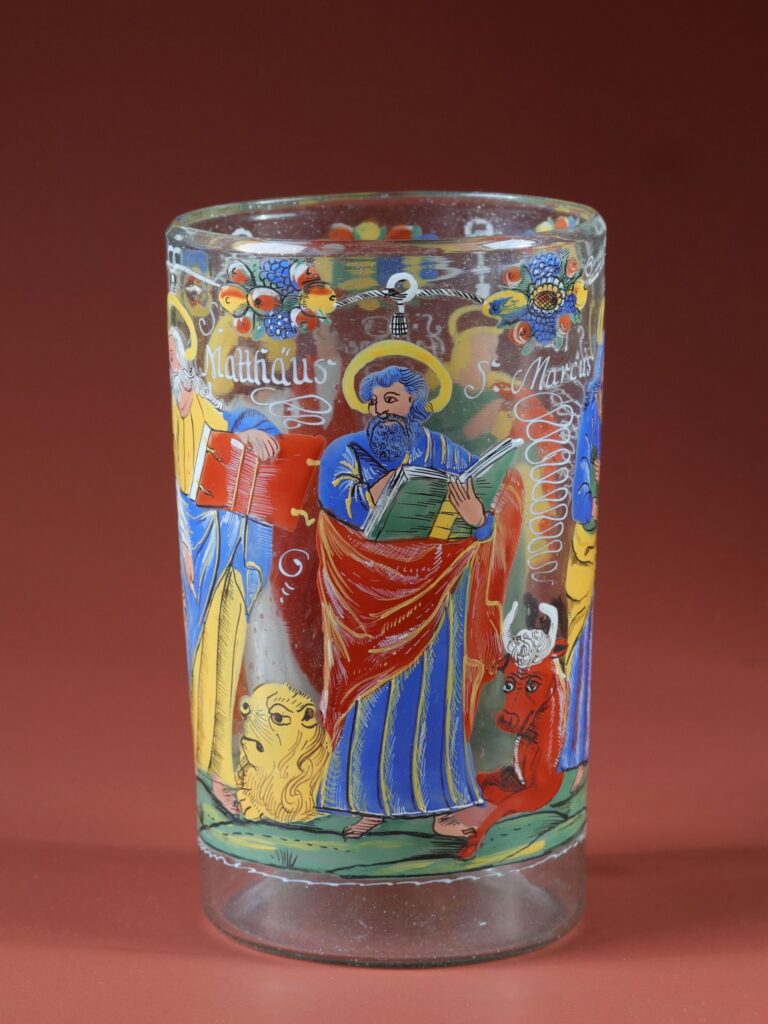
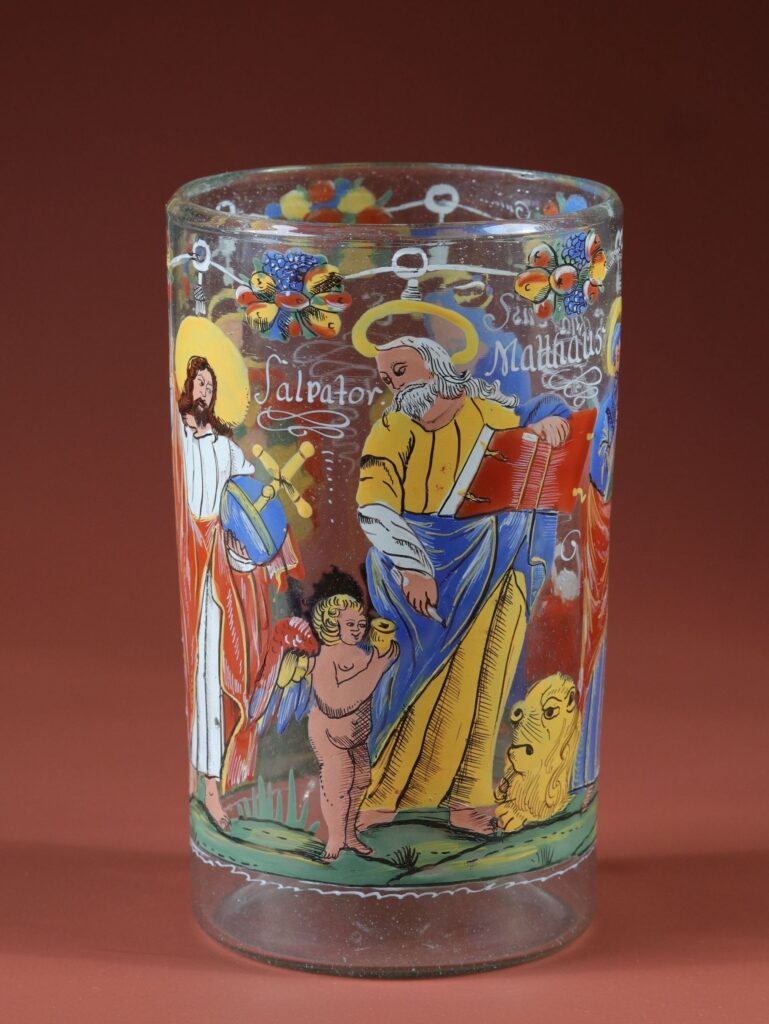
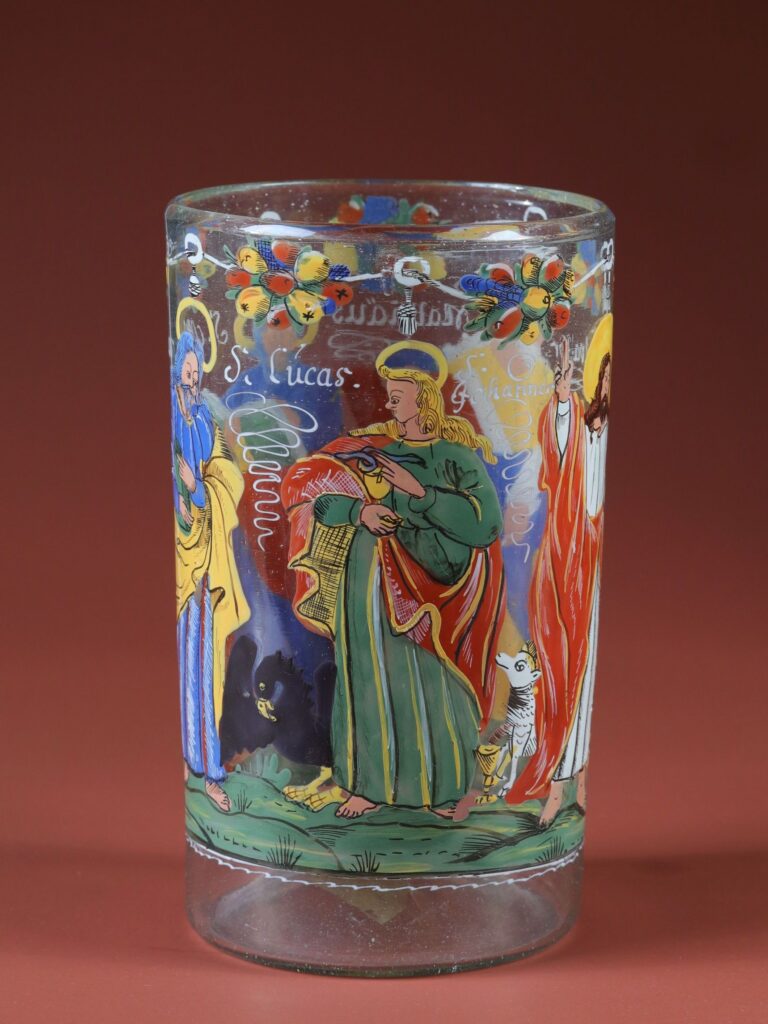
Depicted: Bemalte Gläser by Franz Carl Lipp, 1974, color plate VII
Inspiration: Speyerer Evangelistar – Cod. Bruchsal 1
Dating from around 1220 and ranking among the finest works of German Romanesque book art. The manuscript is renowned for its sumptuous goldsmith binding comprising over 150 individual elements, as well as for its gold-radiant miniatures and initials.
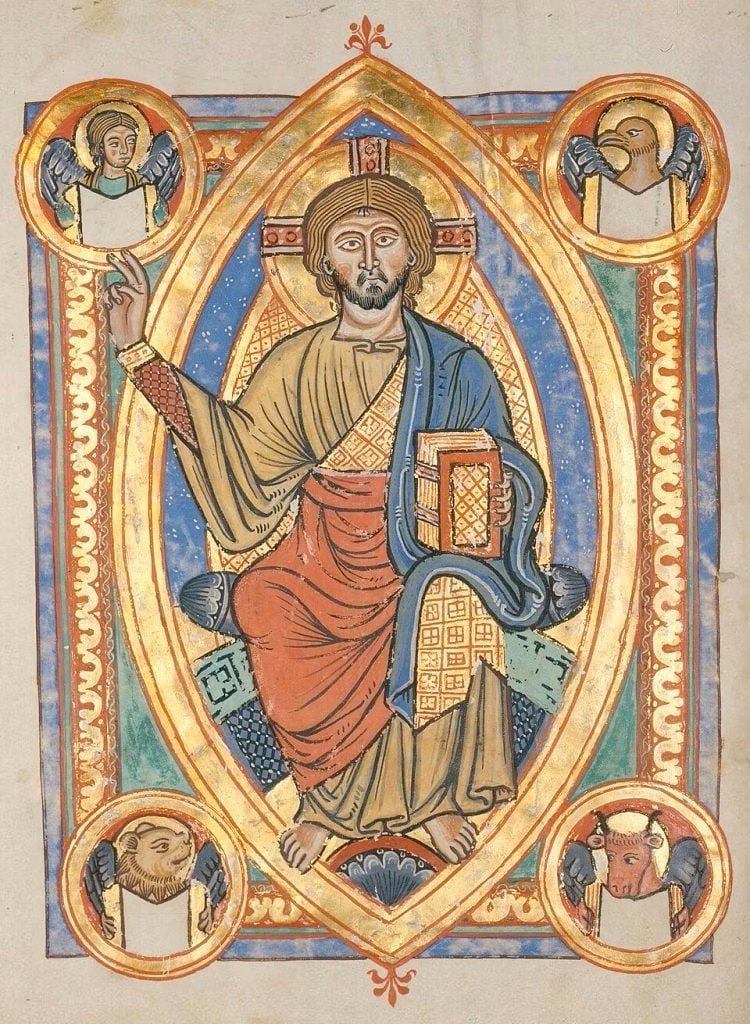
Since early Christianity, the number four has been conceived as representing universal order: four cardinal directions, four winds, four temperaments, four pillars of the Church, among others. The fourfold nature of the Evangelists was integrated into this symbolic numerical framework. Accordingly, the four evangelist symbols were commonly arranged around the figure of Christ Salvator Mundi.
This iconographic arrangement articulates the theological doctrine of ‚Gospel harmony‘ (Evangelienharmonie)—the unified witness of the four Gospels embodied in Christ.“
Das Speyerer Evangelistar
Trier/Speyer (?), um 1220
Badische Landesbibliothek Karlsruhe, Cod. Bruchsal 1, fol. 1v
https://digital.blb-karlsruhe.de/blbdd/content/pageview/1217321
Reference Objects in Literature
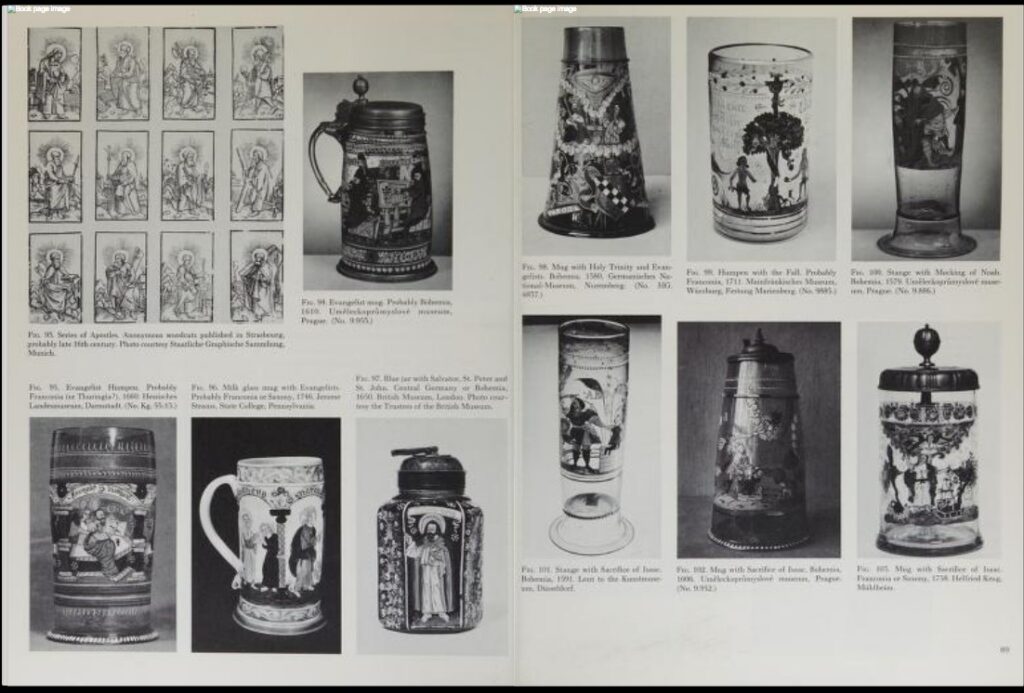
by Corning Museum of Glass 1965 page 88-89
Reference object of the same region and period:
Polychrome enamelled Creussen Bottle ca. 1680
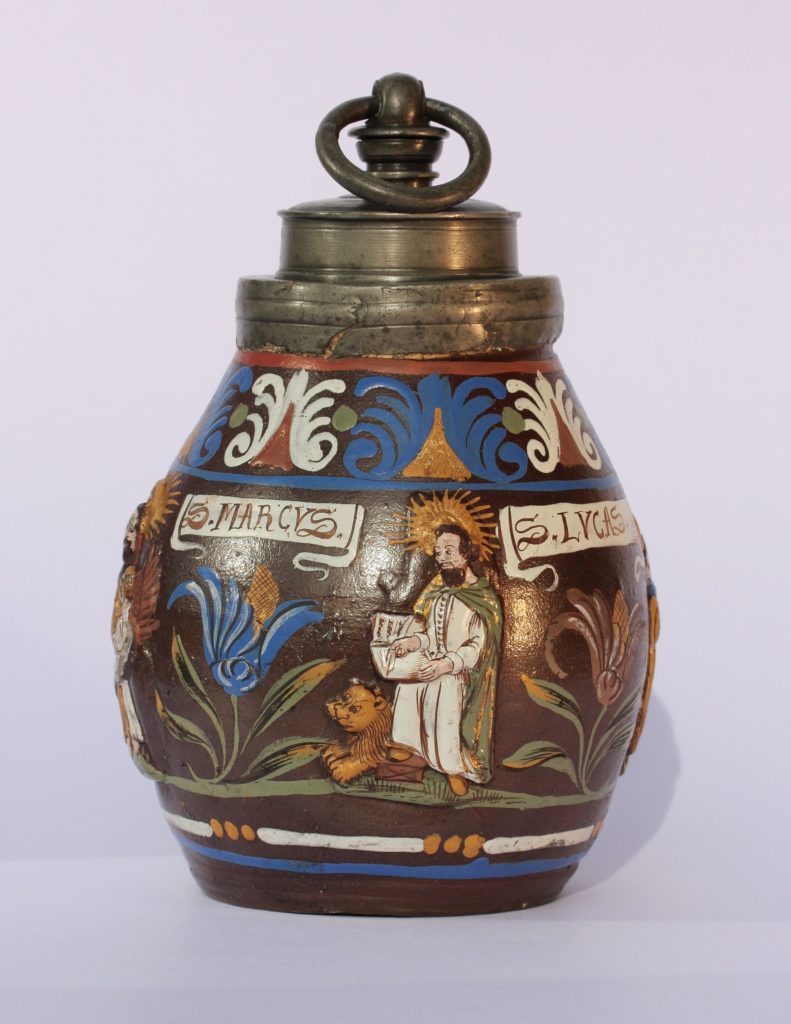
Literature
Internet Archive: German enameled glass; the Edwin J. Beinecke collection and related pieces
by Corning Museum of Glass 1965
Bemalte Gläser. Volkstümliche Bildwelt auf altem Glas. Geschichte und Technik.
Lipp, Franz Carl
Verlag: Georg D.W. Callwey, München, 1974
Related Article
Related link of Museum Digital
Themenportal des Museum Digital
Brandenburgisches Glas. Produktionsvielfalt vom 16. bis zum 18. Jahrhundert
https://themator.museum-digital.de/t/690
Das Themenportal dokumentiert und klassifiziert brandenburgische Glasprodukte aus der Zeit vor 1800, die in öffentlichen und privaten Sammlungen überdauert haben.


