Abraham Helmhack and the Art of the Nuremberg Hausmaler


Nürnberger Hausmalerkrug signiert „AH“ um 1680
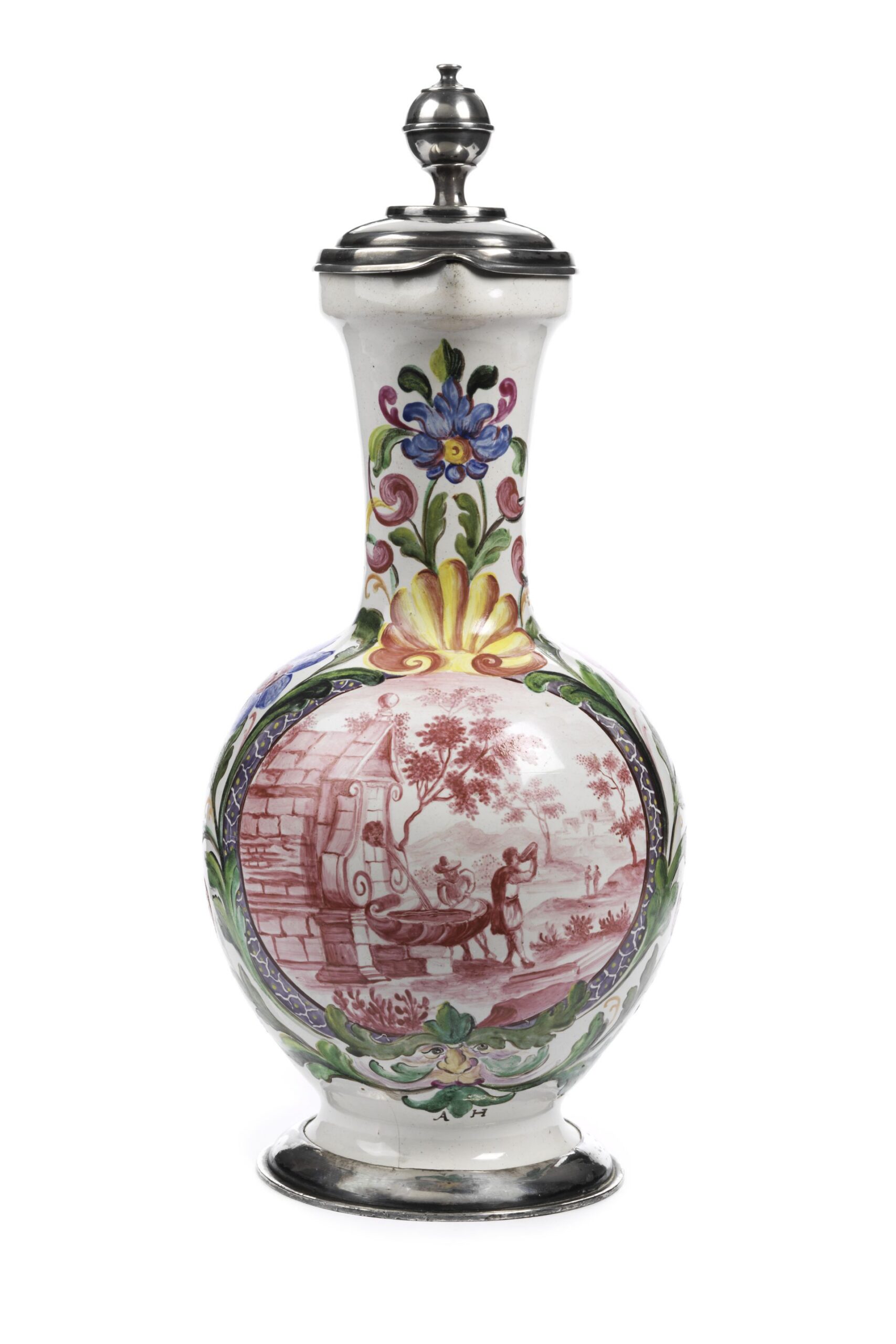
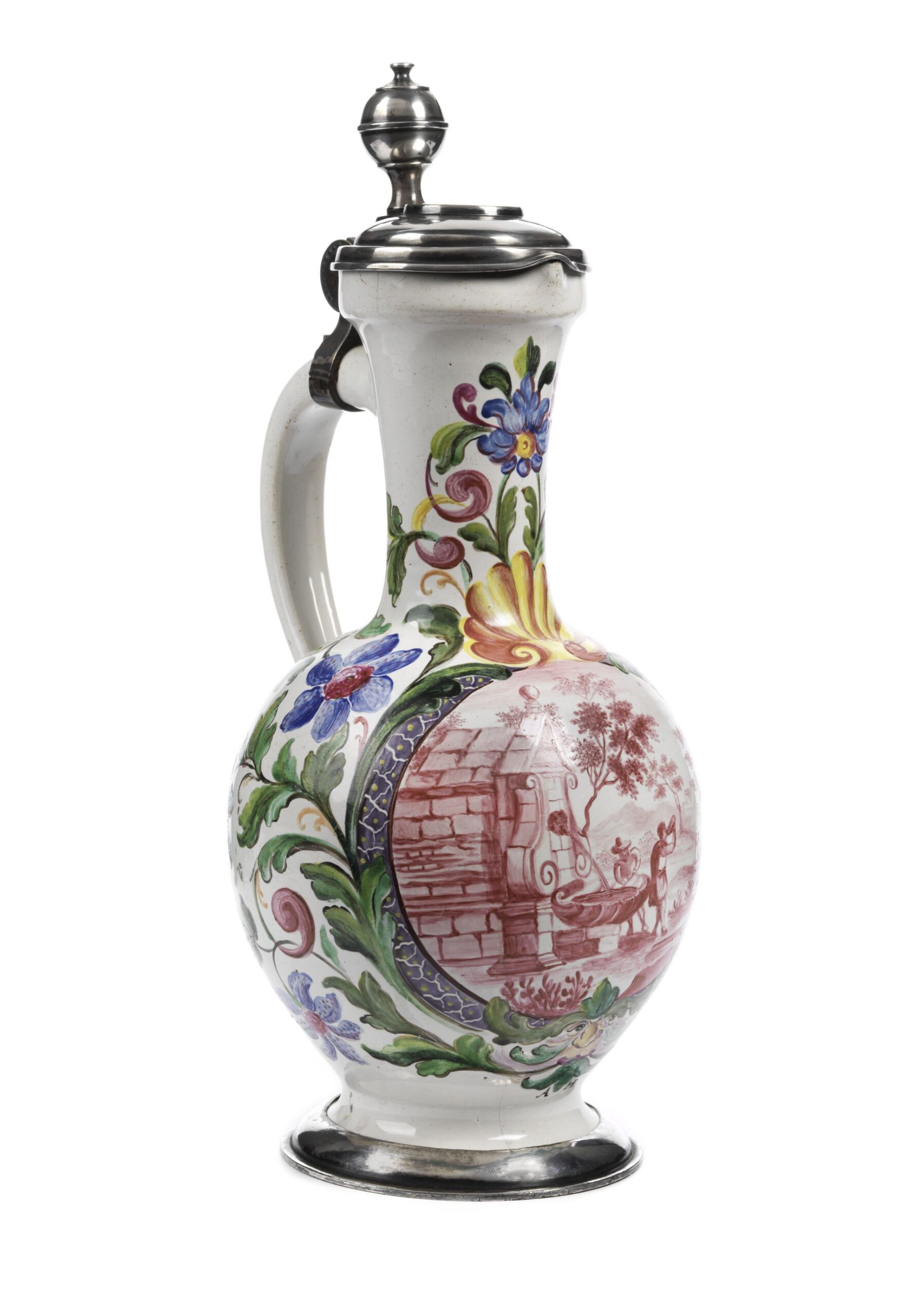
Before the establishment of Nuremberg’s own faience manufactory in 1712, the city’s Hausmaler sourced their wares from Delft in the Netherlands, and subsequently from the German faience centres at Hanau and Frankfurt. The attribution of the ceramic body in this jug is most probably Hanau.
Characteristics of Polychrome Decoration
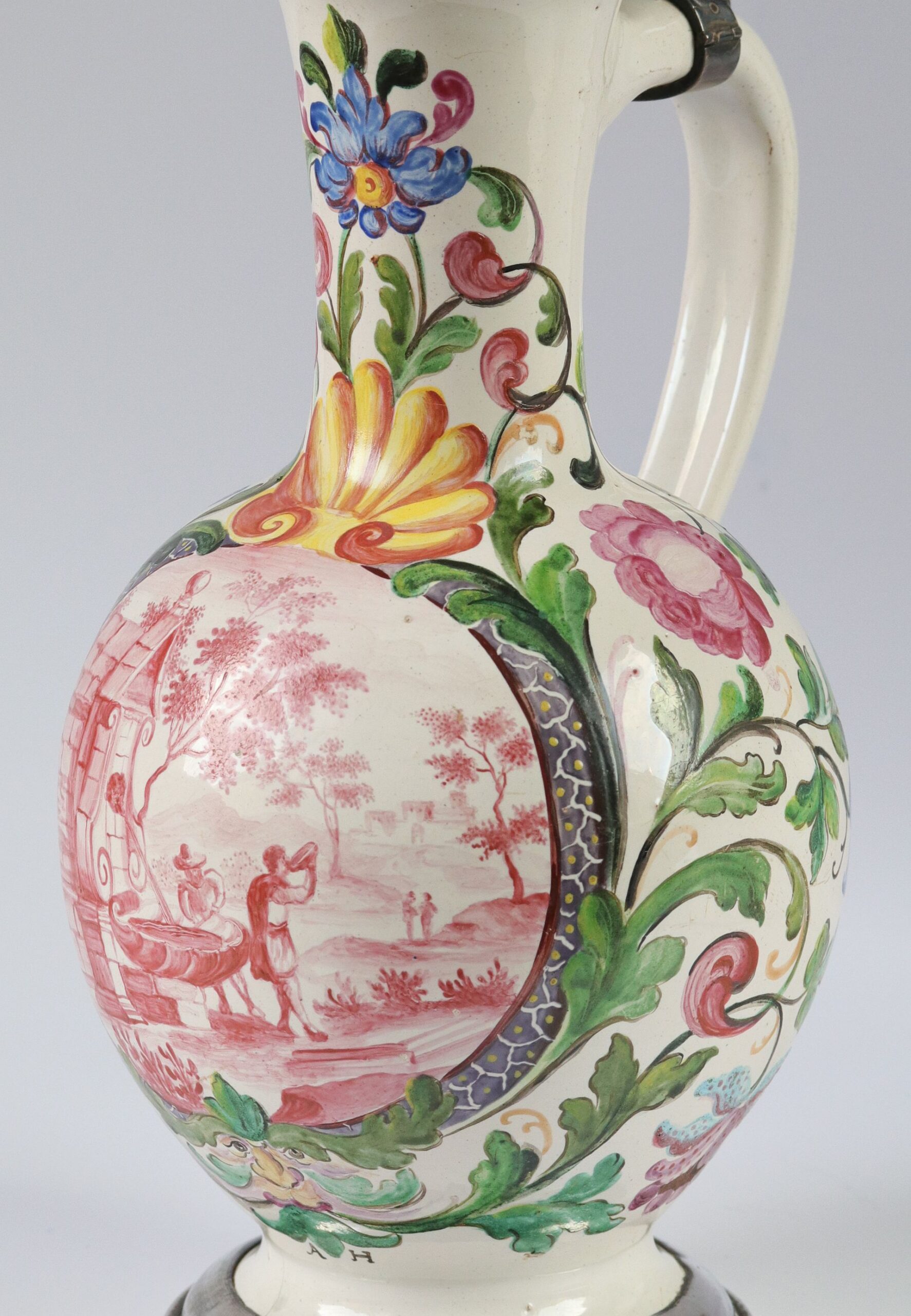
The jug shown here exemplifies all the hallmarks of Helmhack’s mature style. The polychrome floral spray on the neck — bold blue daisy-like blooms, pink scrolling tendrils, yellow shell-like forms — has the confident spontaneity of a master’s brush. The green acanthus border framing its central painted cartouche: a landscape in iron-red (camaïeu rouge), depicting figures beside a fountain, trees, ruins and a distant open landscape. Mascaron at the base of cartouche. The monogram AH, placed at the foot of the vessel, confirms the attribution.
Abraham Helmhack Hausmaler in Nuremberg
Abraham Helmhack was born on 29 March 1654 in Regensburg. At the age of fourteen he was apprenticed to Johann Jacob Behem to learn the glazier’s trade and to develop his drawing skills.
In 1673 he moved to Nuremberg, working initially under Ferdinand Wald before establishing himself as an independent decorator. He died in Nuremberg in May 1724, shortly after his seventieth birthday.
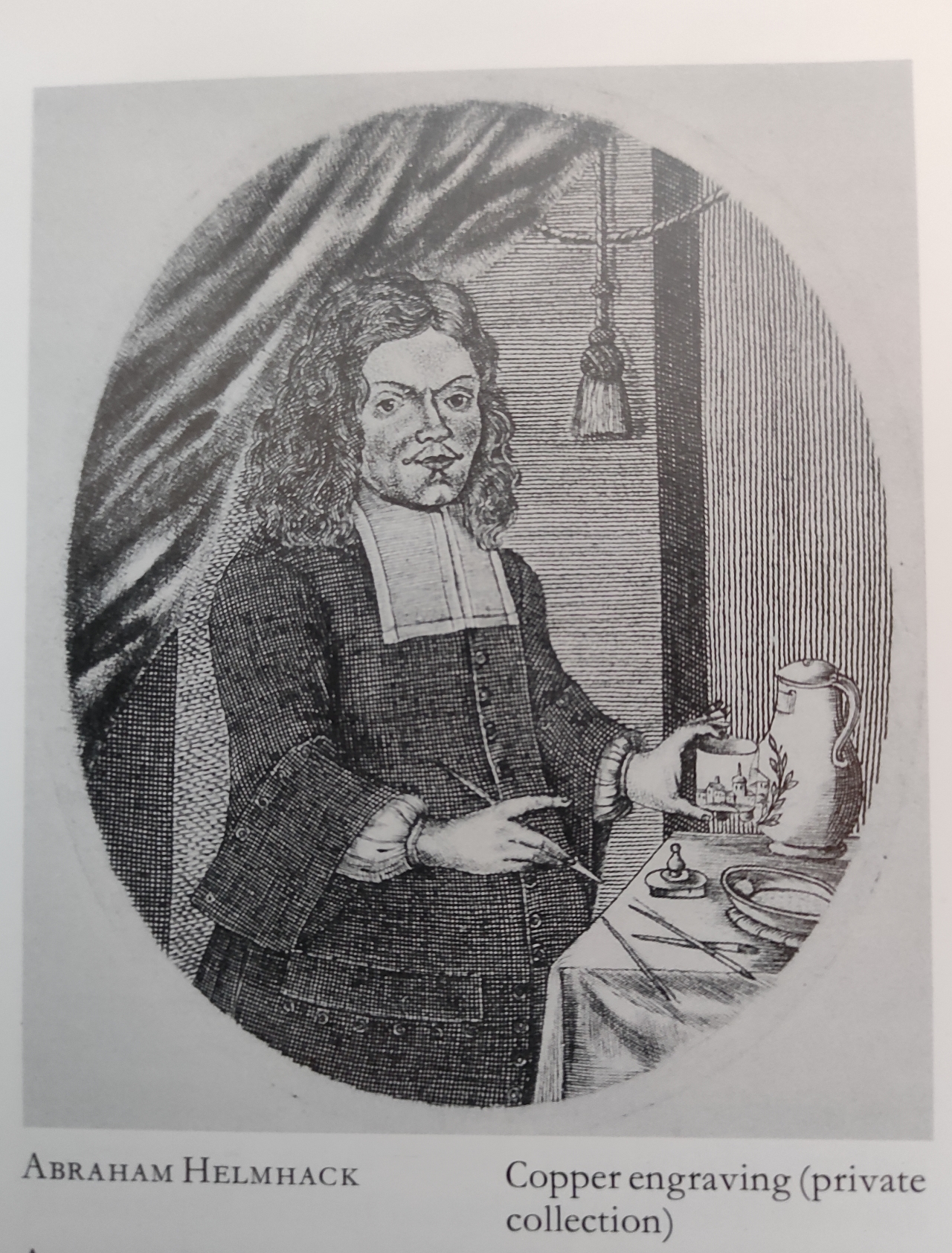
Abraham Helmhack (1654 – 1724)
a contemporary copper engraving portrait of himself shows him with a glass in one hand and a paintbrush in the other
source: Bosch, Helmut: Deutsche Fayencekrüge des 17. und 18. Jahrhunderts. Sammlungen Hans Cohn, Los Angeles. Siegfried Kramarsky, New York.
Mainz: Von Zabern 1983 S. 20
Helmhack’s significance in the history of the Hausmaler lies above all in his mastery of polychrome muffle-fire enamels. His predecessors in the Nuremberg school — Johann Schaper (1621–1670) and Hermann Benckert — had worked predominantly in Schwarzlot, a monochrome black enamel derived from lead and manganese.
Independent Craftsmen in a Guild-Free City
What made Nuremberg uniquely fertile ground for the Hausmaler was the city’s exceptional system of craft regulation: Nuremberg had no guilds. All trade matters were overseen by a municipal authority, the Rugamt, which classified crafts into three categories: sworn trades (with strict regulations), free trades (open to any citizen or resident), and restricted trades. Glass-painting — the technical foundation of Hausmaler decoration — fell under the free trades category. Any craftsman whom the council admitted as a citizen or as a protected resident could practice it without restriction. This attracted talented craftsmen from across the German lands. Of all the known Nuremberg Hausmaler, only Wolfgang Rössler was a native son; the others had migrated to the city, drawn by its commercial culture and liberal trade environment. Clients were affluent aristocrats and patricians.
Engraving Inspiration
Gabriel Perelle (1604-1677) worked, presumably from 1638 onwards, both after his own designs and after compositions by his contemporaries. His etchings concentrate on subjects drawn from the French royal domains, consisting predominantly of landscapes and views of royal châteaux and gardens. source: https://nds.museum-digital.de/people/129617
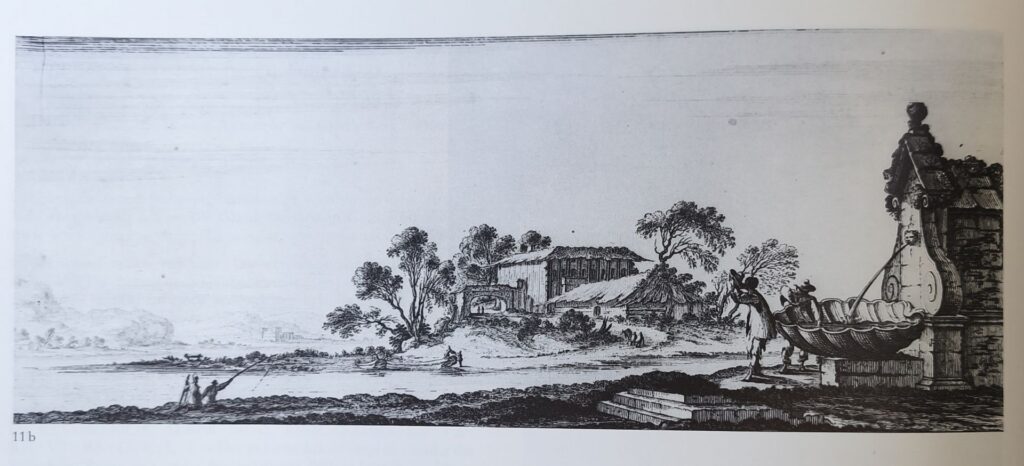
A wide range of Perelles engravings can be found digitalized at the Herzog Anton Ulrich Museum Braunschweig with this link: https://nds.museum-digital.de/objects?persinst_id=129617
Museum Reference Objects
The Metropolitan Museum of Art, New York
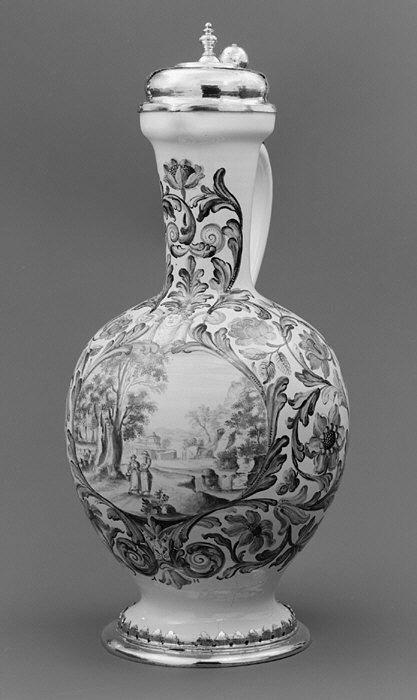
Flagon (one of a pair)
Decorator: Abraham Helmhack (1654–1724)
Silversmith: Hinged cover by Jacob Pfaff (German, Nuremberg, working 1675–1708)
Date: ca. 1690
German, Nuremberg
Medium: Faience (tin-glazed earthenware), silver gilt
Dimensions: H. 13-3/16 in. (33.5 cm)
copyright: Metropolitan Museum
https://www.metmuseum.org/art/collection/search/208007
Victoria and Albert Museum, London
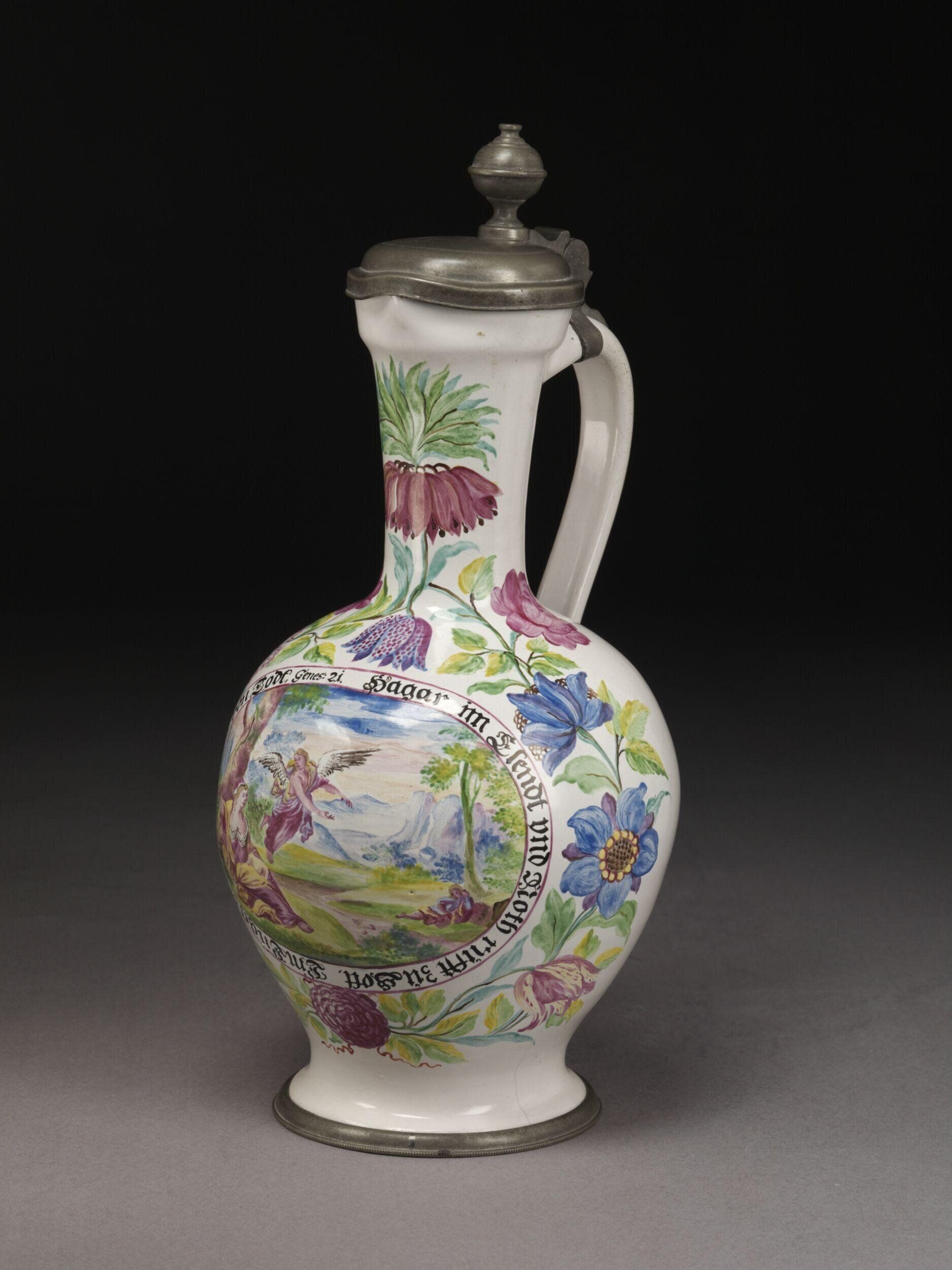
Jug with pewter lid depicting Hagar and the Angel
Painted by Abraham Helmhack, possibly in Hanau, Germany late 17th or early 18th century
Mark: ‚AH‘, in black
Tin-glazed earthenware
copyright: V + A
https://collections.vam.ac.uk/item/O162372/jug-helmhack-abraham/
Germanisches Nationalmuseum, Nürnberg
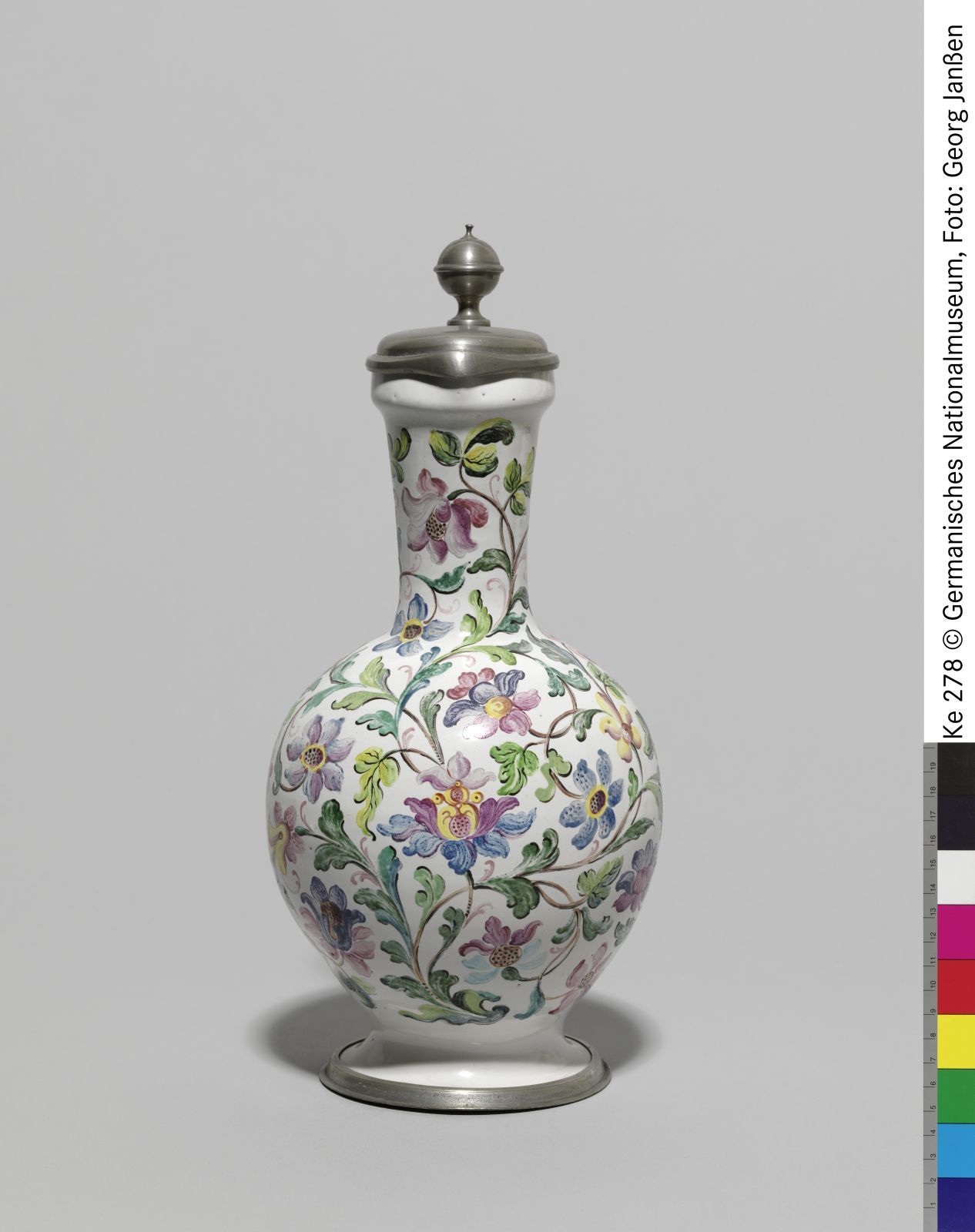
Enghalskrug bemalt mit Ranken und Blüten
Helmhack, Abraham (Fayencemaler)
Herstellungsdatum um 1700
Herstellungsort
Fayence: Frankfurt (?), Hanau (?),
Bemalung: Nürnberg
H. 36,0 cm; B. mit Henkel 19,2 cm, Dm. 17,2 cm; Dm. Fuß 12,0 cm; Gewicht 1400 g
copyright: Germanisches Nationalmuseum
Literature
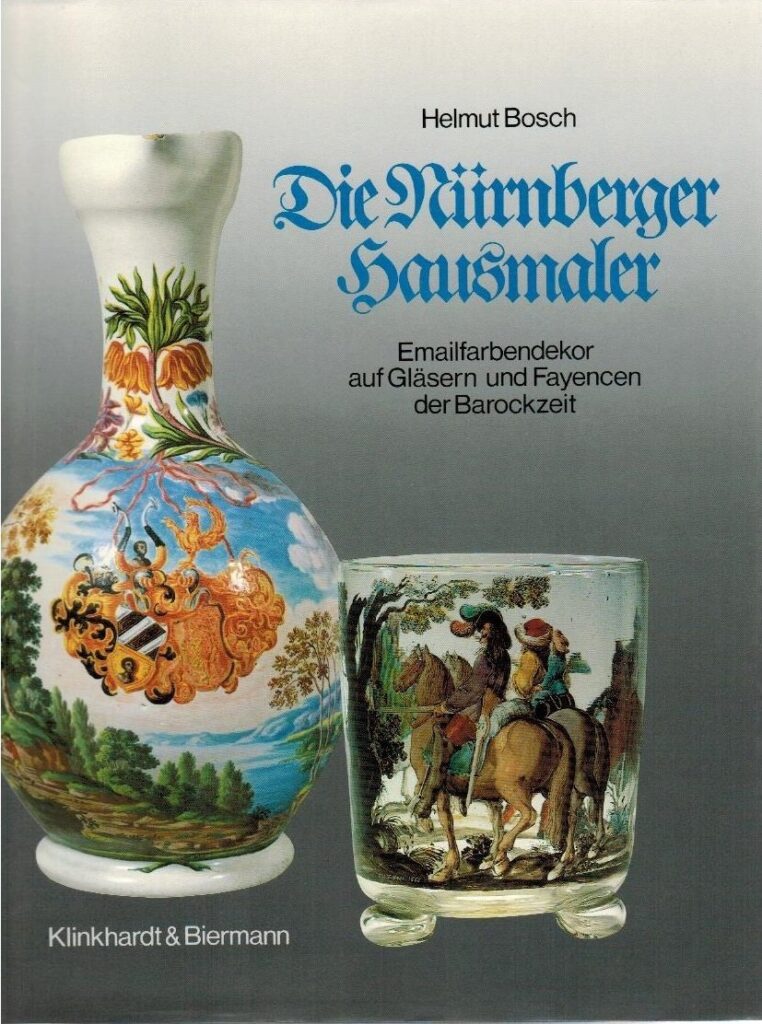
Bosch, Helmut: Die Nürnberger Hausmaler. Emailfarbendekor auf Gläsern und Fayencen der Barockzeit. München, Klinkhardt & Biermann 1984.
S. 258 f
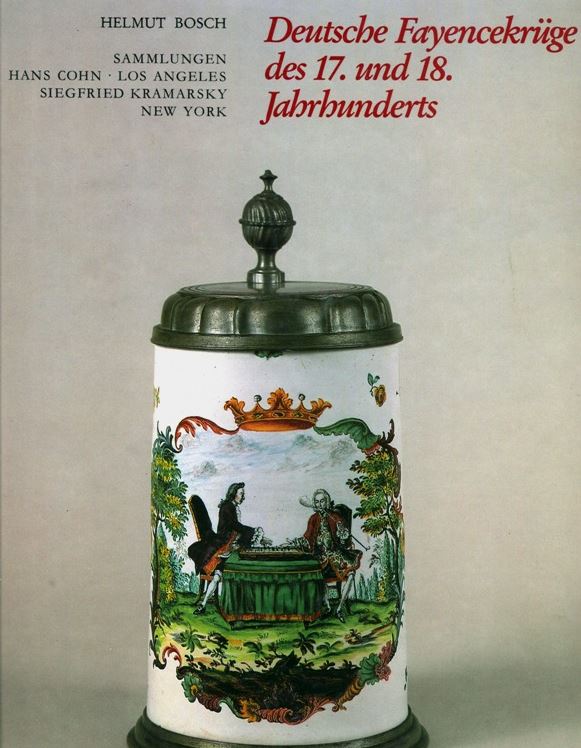
Bosch, Helmut: Deutsche Fayencekrüge des 17. und 18. Jahrhunderts. Sammlungen Hans Cohn, Los Angeles. Siegfried Kramarsky, New York.
Mainz: Von Zabern 1983.
S. 42 f


