Gmunden Faience Hunting Jug Dated 1762


Typology in the Context of the „Blaue Periode“
18th-century faience from Gmunden has its own distinctive characteristics. Katharina Marchgraber describes this impressively in her thesis dated 2008 (see literature below)
Characteristics of the „Blaue Periode“
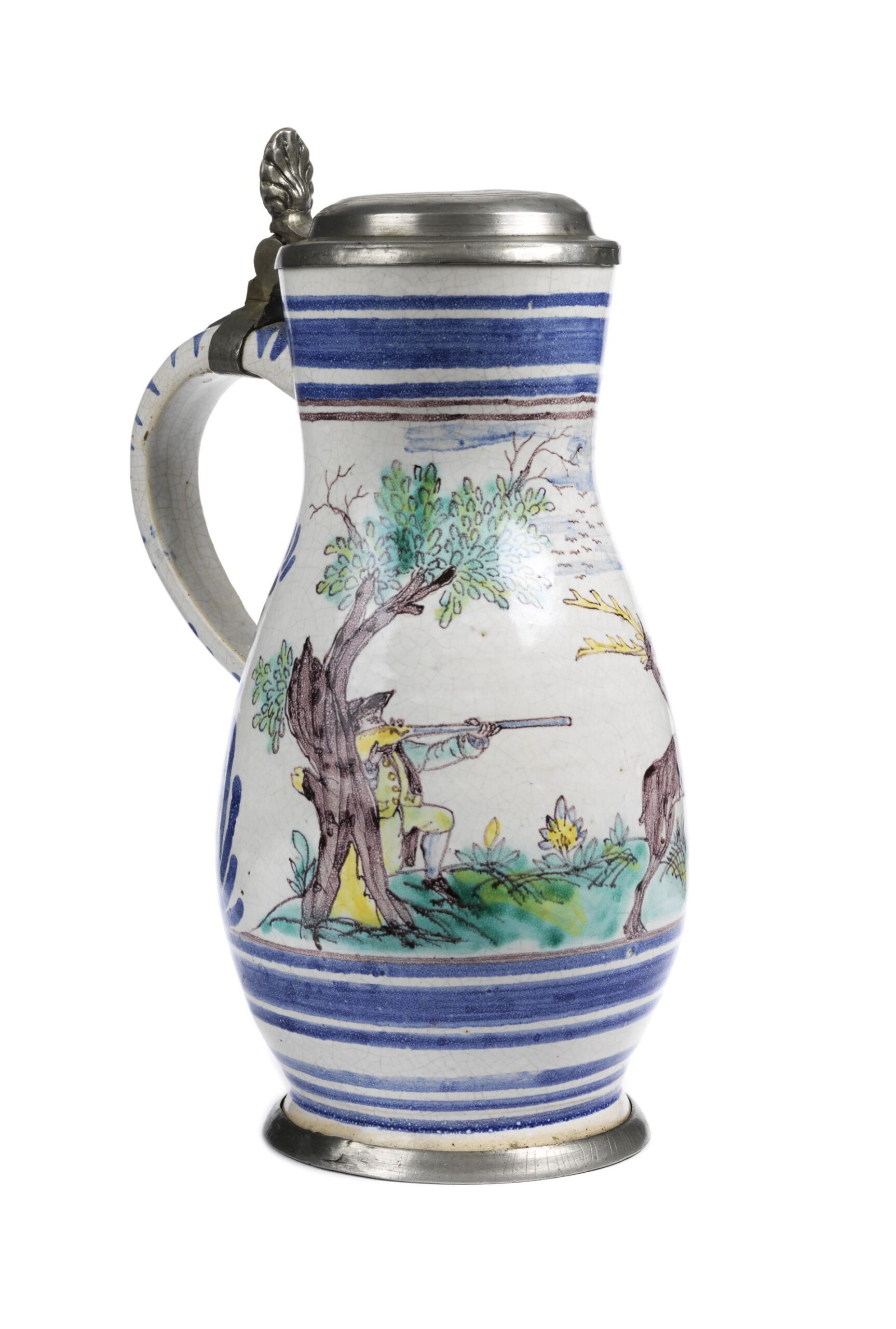
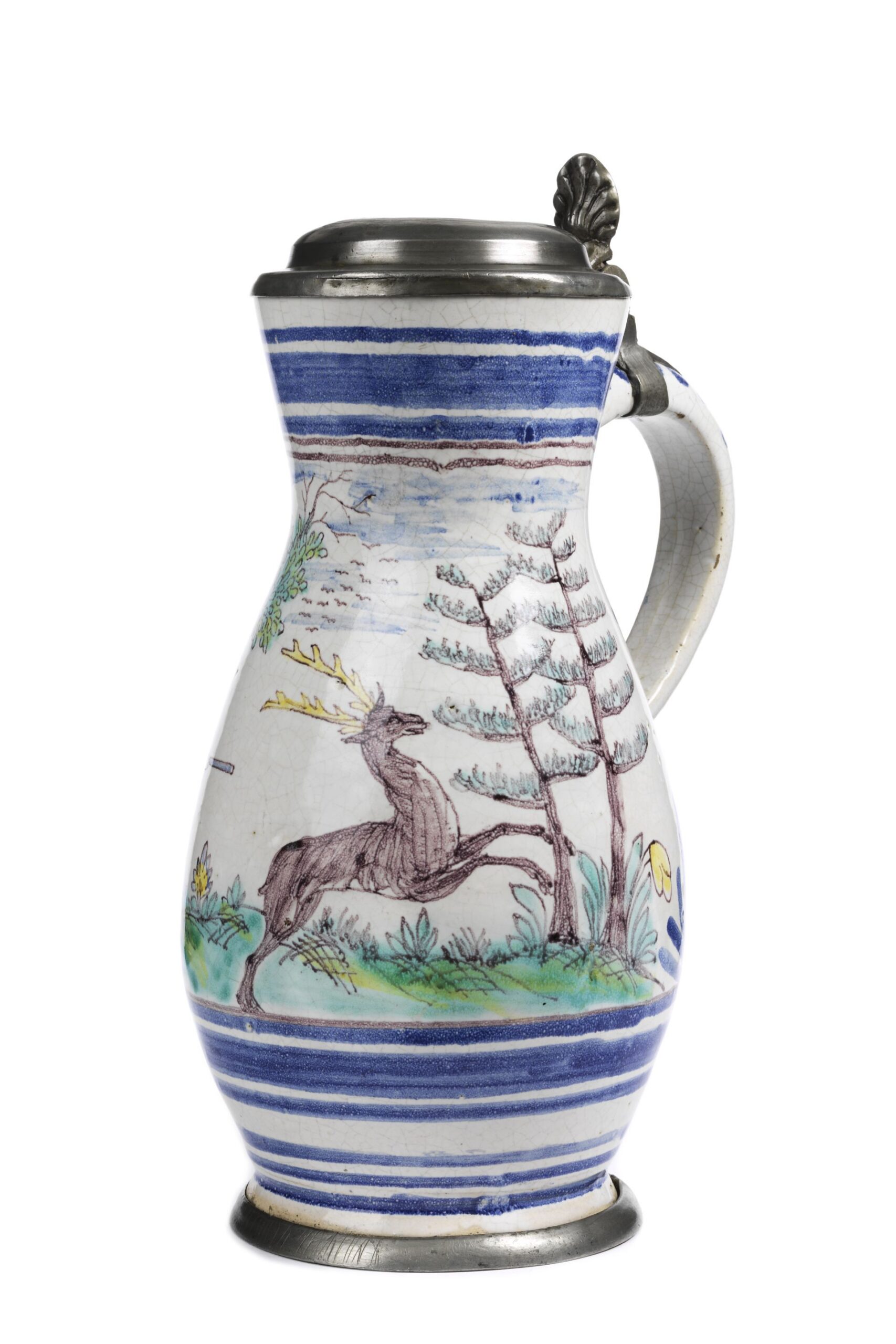
Hunting iconography occupies a prominent place in the decorative repertoire of Gmunden faience. Depiction of hunters with hounds pursuing stag, hare, or other game were very popular.
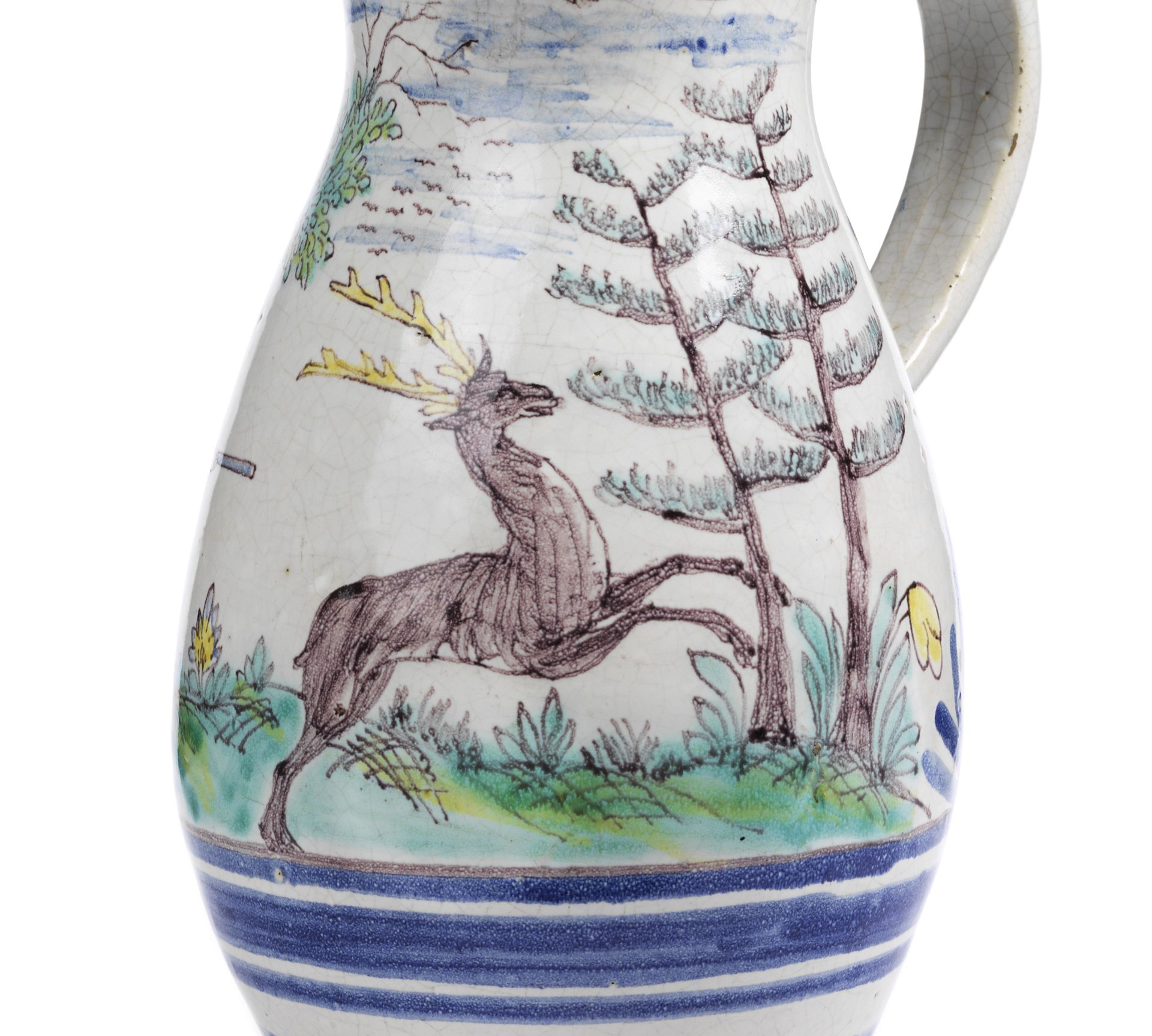
With the dating 1762 the jug would be placed in the late „Blau-bunte Periode“
The predominant shape is that of the pear-shaped jug, the decoration framed with horizontal blue banding at base and shoulder. The handles of most jugs are shaped into a volute or spiral at their lower end. Coulour scheme of the „Blau-Bunte“ Periode consists of cobalt blue, manganese violet-brown, copper green, and antimony yellow
Blue still performs a prominent structural role through the banding, while the figural composition is enlivened by yellow and green, with manganese for game and trees. Marchgraber’s thesis notes that the Gmunden workshops, unlike their aristocratically patronised counterparts in France and Germany, operated without royal or noble protection and were entirely dependent on the tastes of their ‚volksnahe‘ (people-close) clientele: boatmen, salt-traders, craftsmen, farmers, and the lower ranks of the urban bourgeoisie. This commercial autonomy produced an extraordinary vitality of local subject matter e.g. the landscape, the working trades and the Catholic devotional life gives Gmunden faience its aesthetic value.
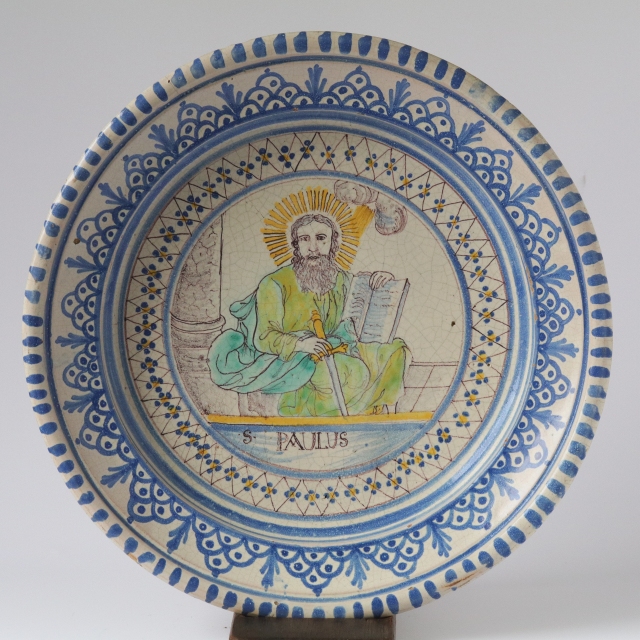
A Gmunden Faience Charger depicting the Catholic devotional life with the iconography of Saint Paul ca. 1760
Gmundner Paulusteller aus der „Blauen Periode“ um 1760, D. 35 cm
Collection Peter Vogt München
Gmunden, situated at the northern shore of the Traunsee in Upper Austria, occupies a singular position in the history of Central European ceramic art. Elevated to the status of a princely town (fürstliche Stadt) by Emperor Frederick III in 1478, the community possessed exceptional preconditions for the sustained production of high-quality pottery: abundant clay deposits in the surrounding Salzkammergut, a navigable waterway for the shock-free transportation of fragile wares, and a flourishing salt trade that connected it commercially to the wider Habsburg lands. These structural advantages underpinned a ceramic tradition stretching from the mid-seventeenth to the mid-nineteenth century, producing a body of tin-glazed earthenware that is among the most distinctive in the Austrian folk-art canon.
The Guild Ordinance and Workshop Organisation
The Gmunden potters formalised their associational life through a guild (Zunft or Handwerksinnung), which until 1625 operated under the Welser Hafnerordnung of 1584. On 12 November 1625, the Gmunden town council confirmed a separate ordinance of twenty-five articles that regulated every aspect of craft life. Workshop ownership was intimately tied to real property. The Hafnerhaus — workshop and dwelling in one — passed within families through inheritance or marriage, generating craft dynasties of remarkable longevity. As Marchgraber notes, ‚certain potter families practised the trade for two to three hundred years,‘ a continuity that fostered both stylistic coherence and the transmission of craft secrets across generations. Of the five principal workshops active in Gmunden from the seventeenth century onwards, the longest-lived was the establishment in the Kueferzeil (later Esplanade 1, Seestadl), which passed through the hands of the Zwischlberger, Wetzlhoffer, Cammerpaur, Bergmayr, Kazbeckh, Prein, Stadler, Both, and ultimately Schleiss families before reinventing itself as the Gmundner Keramik Manufaktur in the early twentieth century.
Museum Reference Object Museum für Volkskunde Wien
Das Volkskundemuseum in Wien holds one of the most culturally significant and extensive collections of Gmunden faience.
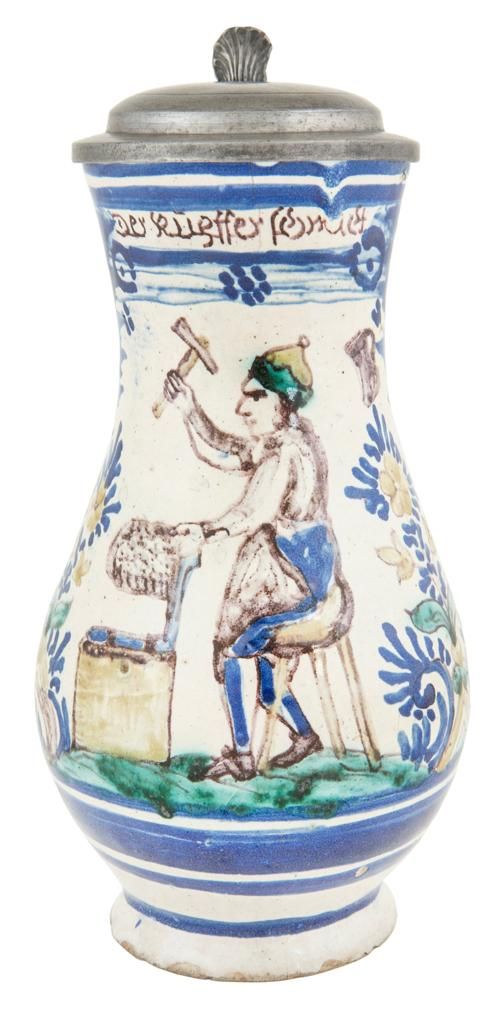
Birnförmiger Henkelkrug mit flachem Boden, ausgestelltem hohem Fuß, ausbiegendem Hals, rundem geradem Rand und Bandhenkel mit eingerolltem Ende. 1. Hälfte 18. Jh
Weiße Grundglasur, innen einfach aufgetragen, wobei der rosa Scherben durchscheint, außen zweifach aufgetragen. Bemalung in allen Scharffeuerfarben vor allem in Blau. Dargestellt ist ein Kupferschmied mit Schürze und Mütze, der auf dem Amboss einen Gegenstand mit dem Hammer bearbeitet, darüber Inschrift in ungelenker Schrift. Daneben blau gefiederter Blütenspross, über und unter dem Bildfeld horizontal umlaufende blaue Bänder. Der Henkel ist quergestreift und seitlich davon gibt es breite Flächen mit blauem Wischdekor.
H: 18,2 cm H mit Deckel: 21 cm D Boden: 6,8 cm D Rand: 7,2 cm D max: 14 cm
Volkskundemuseum Wien / Foto: Christa Knott CC BY 4.0
Museum Reference Object Victoria and Albert Museum London
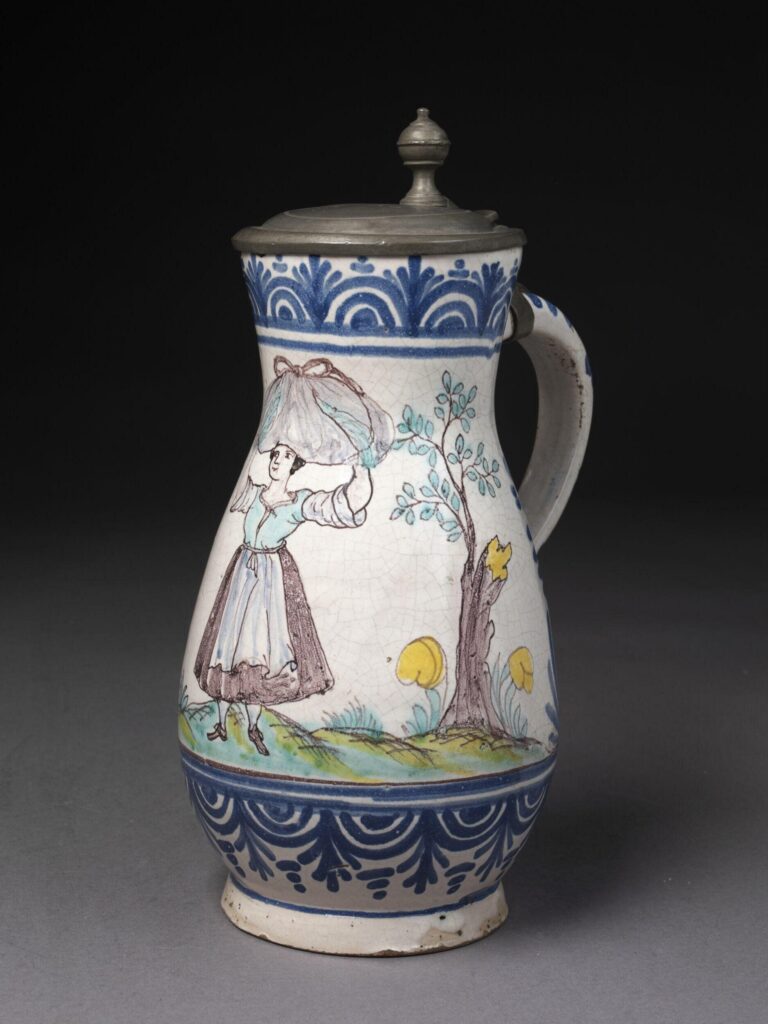
Jug of tin-glazed earthenware painted in colours. With attached pewter lid. Austrian, Gmunden, about 1750-70.
Pear-shaped with a wide neck (without lip spout) and a loop handle. Painted in manganese, bluish green and yellow with a woman standing between two trees and holding a bundle on her head. At the top and bottom are borders of cresting in blue and the handle is barred with feathery scrolls above its lower termination.
Dimensions
Height: 26.4cm
Diameter: 12.4cm
© Victoria and Albert Museum, London
https://collections.vam.ac.uk/item/O337211/jug-gmunden-pottery/
Museum Haus der Keramik Gmunden
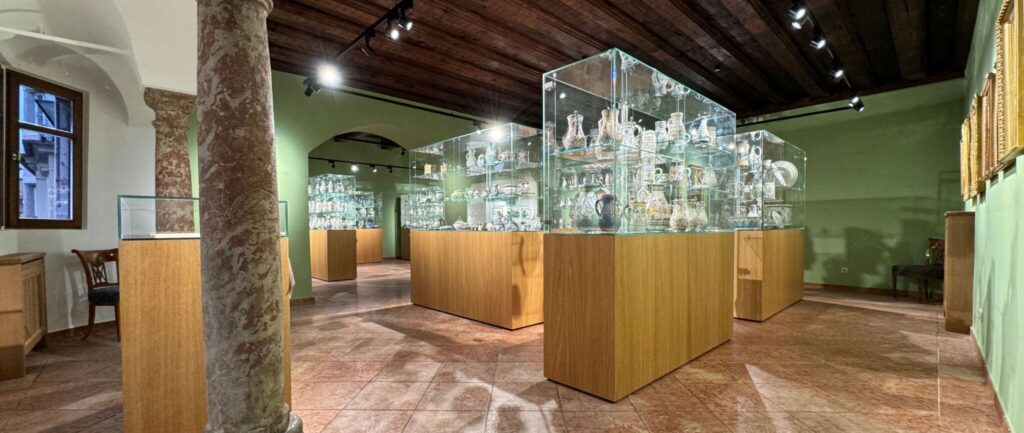
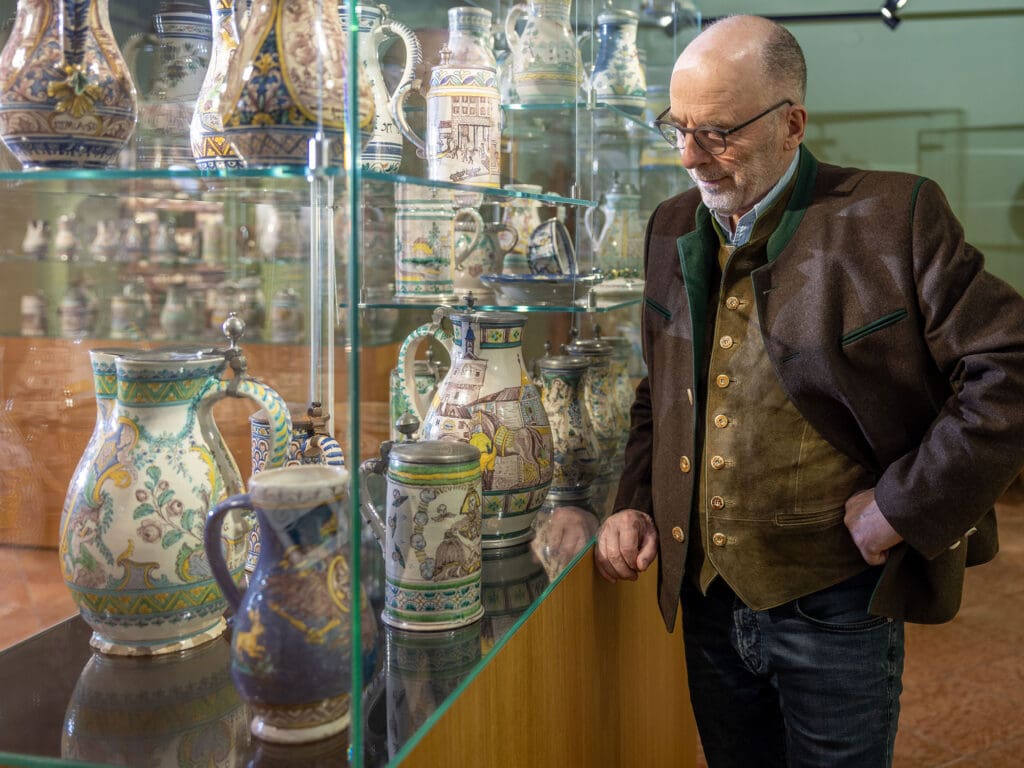
The House of Ceramics in Gmunden is a museum that celebrates the region’s rich tradition of ceramic art. Its roots date back to 1492, when the stove-making trade in Gmunden was first mentioned in writing. Starting in the 17th century, the faience technique found its way into Upper Austria. Faience refers to vessels with a white glaze onto which patterns and images are applied in vibrant colors ranging from blue, green, and yellow to brown and violet. The idea for the exhibition of the presented objects stems from the initiative of collector Ernst Grabner. In addition to the estate of collector Franz H. König-Hollerwöger, this unique collection consists of exceptional pieces of Old Gmunden faience, which Ernst Grabner lovingly assembled over his more than 50 years of collecting.
Literature
Frühe Gmundner Fayence
bis zur Mitte des 19. Jahrhunderts
Katharina Marchgraber
Wien 2008
Link zur Diplomarbeit:
http://othes.univie.ac.at/1098/1/2008-09-15_0002754.pdf
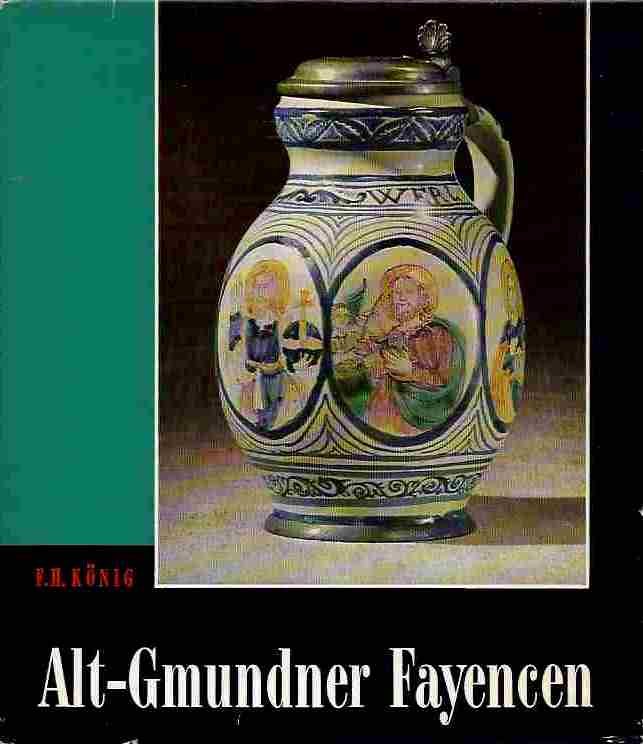
König, F. H.
Alt-Gmundner Fayencen.
Eine Handwerkskunst aus dem Salzkammergut (17.-19.Jhd.).
Linz, Verlag J. Wimmer
Erschienen: 1964.
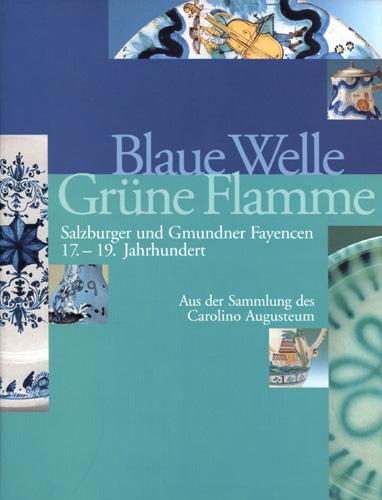
Svoboda, Christa. Blaue Welle – Grüne Flamme: Salzburger und Gmundner Fayencen 17. bis 19. Jahrhundert. Aus der Sammlung des Carolino Augusteum. Salzburg: Salzburger Museum Carolino Augusteum, 1999.


