Rare Turquoise Dippoldiswalde Stoneware


Seltener Dippoldiswalder Posamentenhumpen um 1680
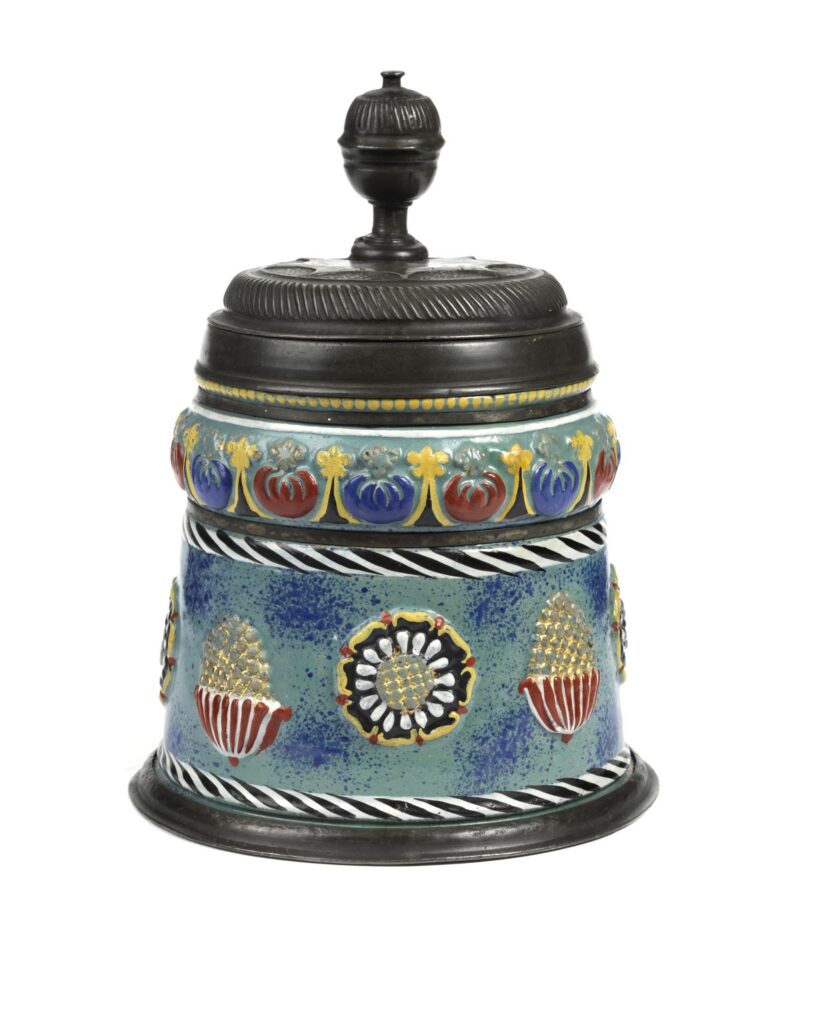
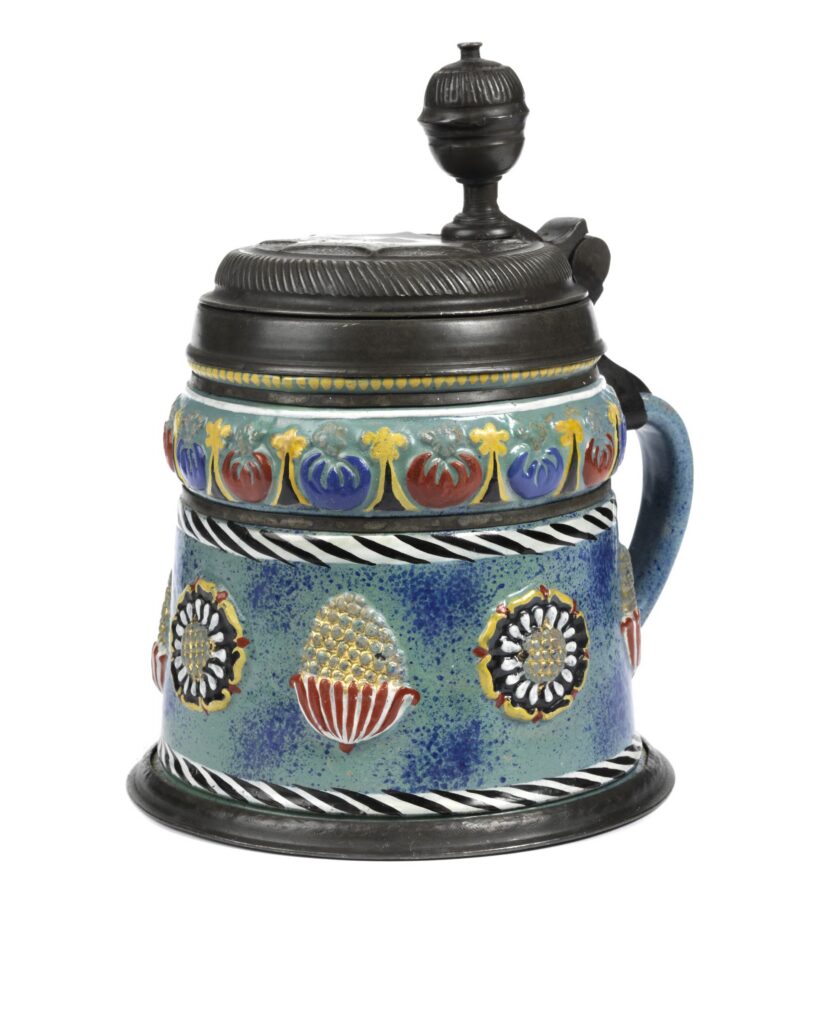
Characteristics: Posamentenhumpen
The heyday of craftsmanship of Dippoldiswalde Stoneware was the second half of the 17th century. Among the most distinctive products of the Dippoldiswalde (formerly attributed to Annaberg) workshops are the so-called Posamentenkrüge — objects whose name derives from the passementerie (braiding) trade of the surrounding Saxon Erzgebirge region of the time.
Horschik notes that light blue or turquoise-green (hellblau oder türkisgrün) ground colours on cylindrical or pear-shaped pieces belong to the core Annaberg/Dippoldiswalde Posamentenkrug group.
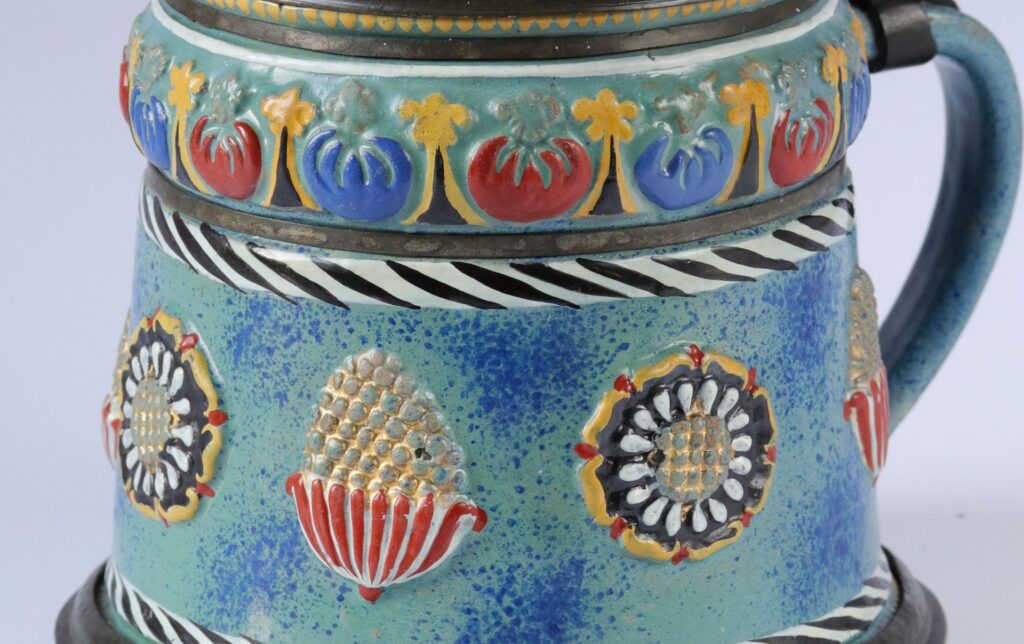
The turquoise enamel ground was applied over the characteristic dark brown slip (Engobe) as a post-firing enamel colour. The relief consisting of rosettes of varying sizes, palm fruit – partly guilded – or pomegranates (Granatäpfel) decorated in polychromie.
The turquoise ground applied after the stoneware’s initial sintering fire is a technically demanding step that accounts for its comparative rarity in the surviving corpus.
Horschik, Josef. Steinzeug: 15.–19. Jahrhundert; von Bürgel bis Muskau. Ebeling, 1981, pp. 231–232.
Dated Dippoldiswalde Stoneware Objects
Dated reference objects in the overview of Anne Barth: Nr. 6 and Nr. 7 are both with turqoise glaze and part of the collection at the Germanische Nationalmuseum Nuremberg and the Grassi Museum Leipzig
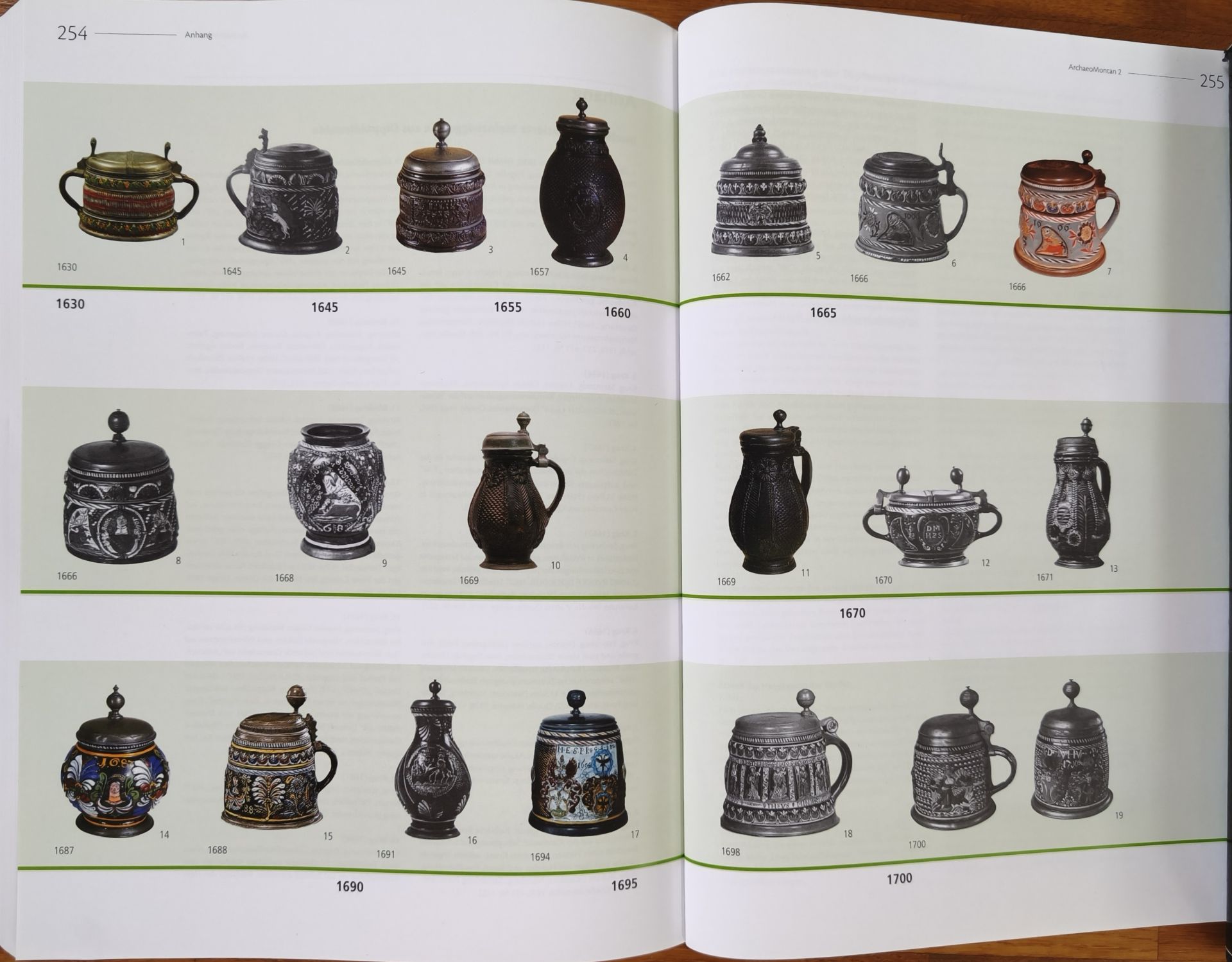
6. Krug (1666) Steinzeug, Engobe, darüber türkisgrüner Fond, drei große und zwei kleine Blattrosetten, zwei liegende Hirsche, Blüten auf Randwulst, Emailfarben. Jahreszahl 1666, Zinnmonzierung mit Stadtmarke C Crimmitschau, Höhe 17,5 cm (Standort: Nürnberg, Sammlung Porst, Inv-Nr. 177, Quelle: Horschik 1978, 411 Nr. 119)
7. Krug (1666) Steinzeug, Engobe, Glasur, Emailbemalung, hellblaue Grundierung, Hirsche, Blüten, Akanthusblattfries, gemalte Datierung 1666″, Zinnmontierung eingravierte Datierung 1692. Höhe 11,5 cm (Standort: Grassimuseum Leipzig I-N1908.93)
Anne Barth: Dippoldiswalder Steinzeug S. 253 ff
Attribution: Annaberg | Dippoldiswalde
Speculations on attributions of Dippoldiswalde stoneware since the middle of 19th century have been manifold. Ranging from mere speculations to serious research based on pewter marks and coat of arms to determin a place or origin. At the middle of 20th century Annaberg was most probable as the location of the productions of these ceramic objects. A very good description of the development of the attribution of Dippoldiswalde stoneware since the middle of the 19th century can be obtained by the standard reference Horschik Steinzeug p 217 ff (Horschik, Josef. Steinzeug: 15.-19. Jh.; von Bürgel bis Muskau. Ebeling, 1981.) So I do not want to go into this any further, as these longstanding discussions came to an end at the turn of the century with excavations that have been taking place in the Dippoldiswalde area and produced finds of “Annaberg type” molds and fragments. As a result the state of research as of today is that Dippoldiswalde is the origin of these stoneware objects formerly attributed to Annaberg.
Reference Object Museum Heylshof Worms
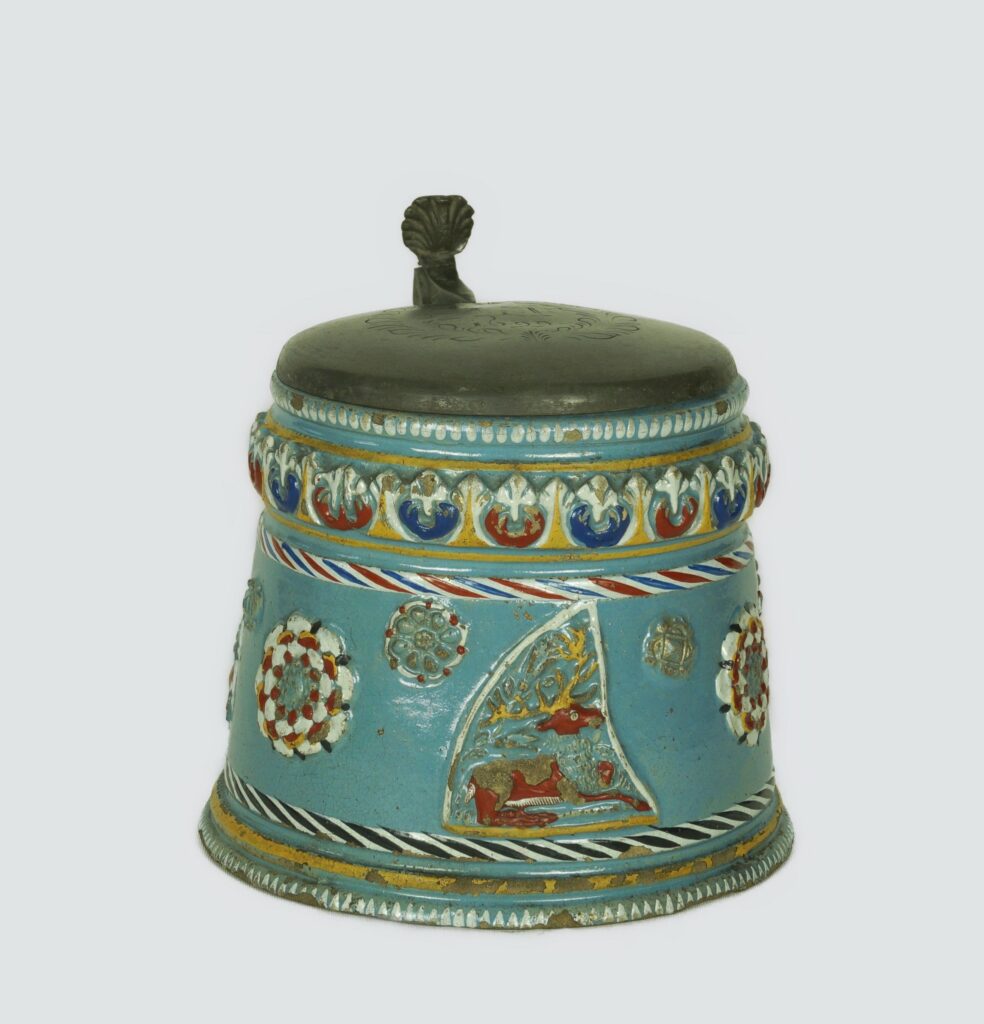
Sachsen ca. 1680
Walzenform; auf der Wandung drei geschweifte Felder mit liegendem Hirsch, dazwischen große und kleine Rosetten;
Randwulst mit Palmettenfries; hellblauer Grund; flacher Henkel; H: 13,7 cm; D: 15,6 cm
Deckel aus Zinn, graviert: „M. T. 1699“.
© Museum Heylshof & U. Felden ; Licence: CC BY-NC-SA
https://nat.museum-digital.de/object/1210689
Reference Objects – Literature
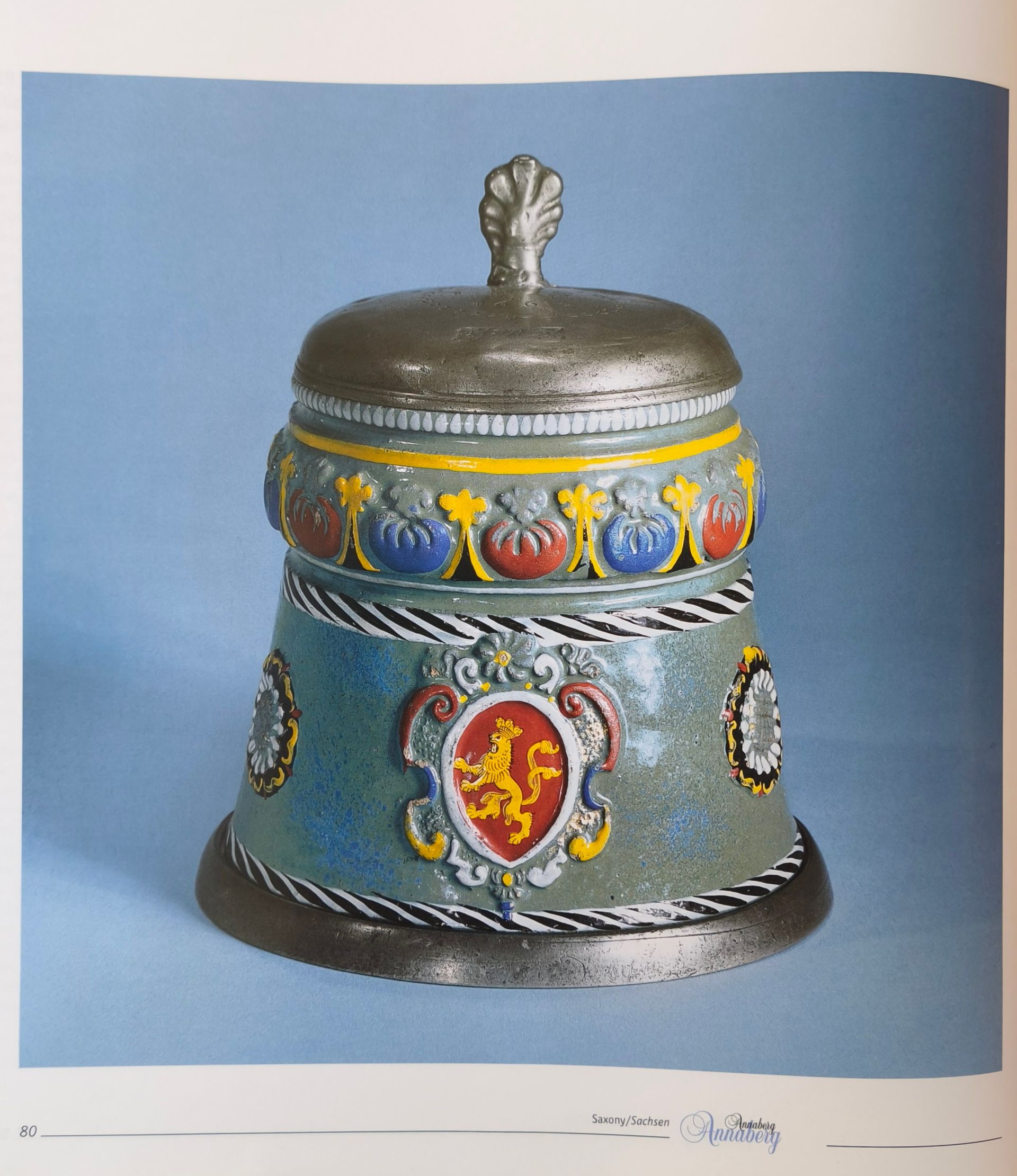
30
Annaberg Posamentenkrug
um 1660/70
Hart gebrannte Irdenware Deckel dat. 1667
H. 15,0 cm
Adler, B. (2005). Early stoneware steins from the Les Paul Collection p. 80
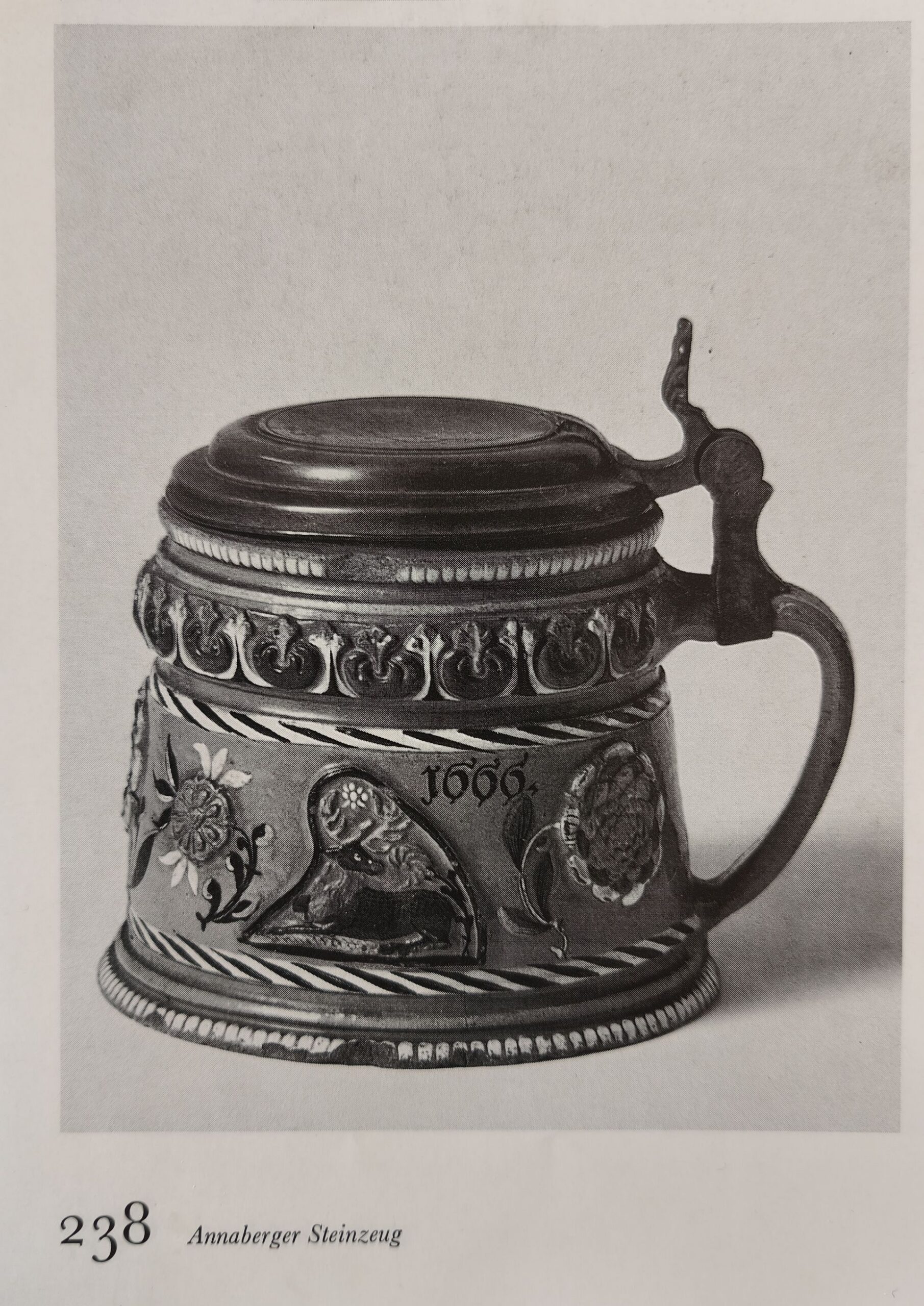
119/ Krug, leicht konisch; eingezogener Lippenrand, Gurtfurche in Randzone und unter Reliefwulst, konischer Standring mit Gurtfurche, Bandhenkel. Steinzeug mit Braunsteinengobe und Salzglasur, darüber türkisgrüner Fond. Reliefdekor: drei große und zwei kleine Blattrosetten, zwei liegende Hirsche; stilisierte Blüten auf Randwulst. Emailfarben: Türkis-grün, Blau, Rot, Gelb, Weiß, Schwarz; gemalte Jahreszahl <<1666>». H. 11,5 cm, Annaberg um 1666. Zeitgen. Zinnmontierung mit Stadtmarke C = Crimmitschau/Erzgeb. Nürnberg. Slg, Porst, Inv. Nr. 177
Josef Horschik, Steinzeug: 15. bis 19. Jahrhundert; von Bürgel bis Muskau, 1978 S. 238
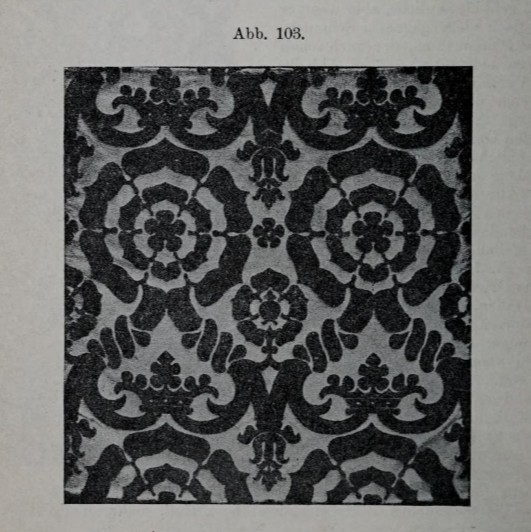
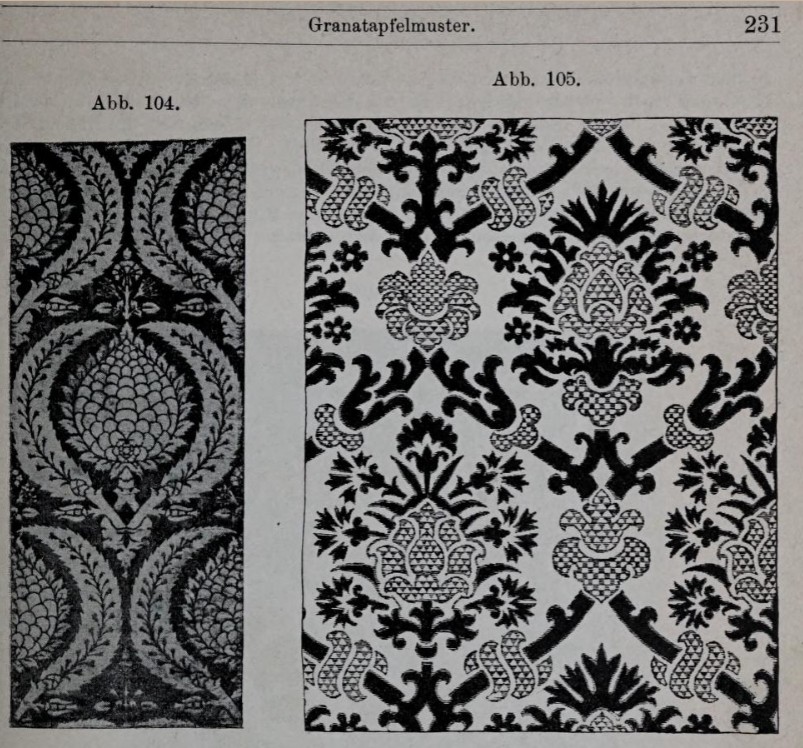
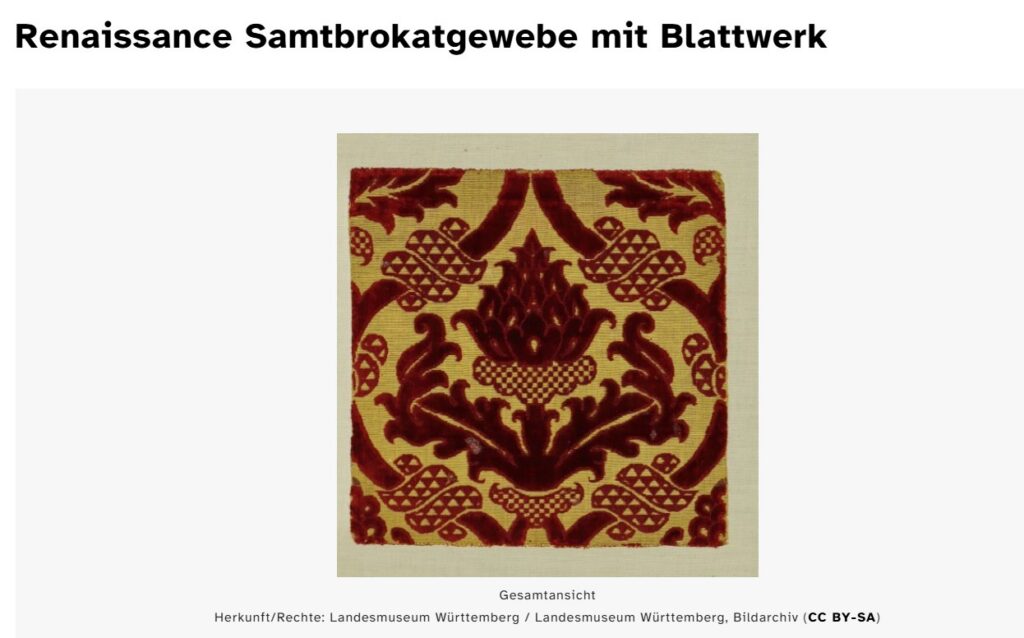
Inspiration – Design on Textile
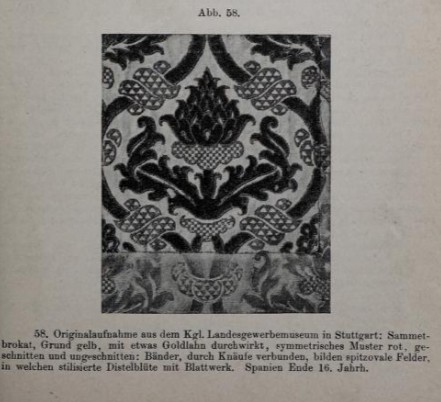
Handwörterbuch der Textilkunde aller Zeiten und Völker für Studierende, Fabrikanten, Kaufleute, Sammler und Zeichner der Gewebe, Stickereien, Spitzen, Teppiche und dergl., sowie für Schule und Haus, bearbeitet von Max Heiden, Stuttgart 1904 – access digital internet archive https://archive.org/details/handworterbuchde00heid_0
translated and condensed:
The Pomegranate Motif: From Medieval Textiles to Saxon Stoneware
The pomegranate pattern (Granatapfelmuster) has one of the longest decorative histories in European applied arts. Its origins lie in antiquity, where the fruit carried strong symbolic resonance, traceable through Coptic textile fragments and into the woven silks of 14th-century Italy, where it developed under sustained Arab influence.
Closely related ornamental forms ran parallel to it: the pine cone (Pinienzapfen), already known in Assyrian ornament; the thistle; and later the pineapple — all belonging to the same family of pointed, seed-bearing fruit forms that European and Oriental decorative traditions drew upon interchangeably.
The mature Granatapfelmuster flourished from the 15th into the 16th century across the Ottoman world, Italy, Spain, and Flanders, generating hundreds of variations. Its characteristic pointed-arch framing (Spitzbogenumrahmung) reflects the decisive contribution of the Gothic style to what was fundamentally an Oriental motif — a formal synthesis that produced one of the most persistent patterns in Western decorative art.
As the Renaissance advanced, the pointed arch grew smaller and the surrounding floral wreath increasingly elaborate, until by the early 16th century the motif appeared in its most complex form, with crowns connecting individual repeats. In Spain, the pomegranate and pine cone alternated within pointed-oval fields — marking the transition to the Renaissance decorative vocabulary. By the late 17th century, a related revival emerged in French Baroque textile design, now grounded in the pineapple rather than the pomegranate proper.
This long textile lineage makes the pomegranate appliqués on the Dippoldiswalde Posamentenkrug all the more legible: the Erzgebirge potters were not working in isolation but drawing on a pan-European ornamental vocabulary with roots stretching back through Renaissance silk-weaving to the medieval Orient — entirely fitting for a vessel whose very name honours the textile trade.
Source: Heide, [Handwörterbuch der Textilkunde]. Available via Internet Archive: archive.org/details/handworterbuchde00heid_0
Literature
Adler, B. (2005). Early stoneware steins from the Les Paul Collection: A survey of all German stoneware centers from 1500 to 1850.
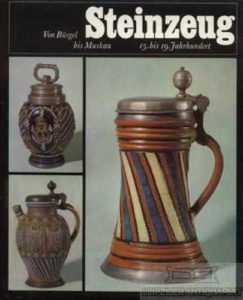
Josef Horschik, Steinzeug: 15. bis 19. Jahrhundert; von Bürgel bis Muskau, 1978
Seiten 217 ff.
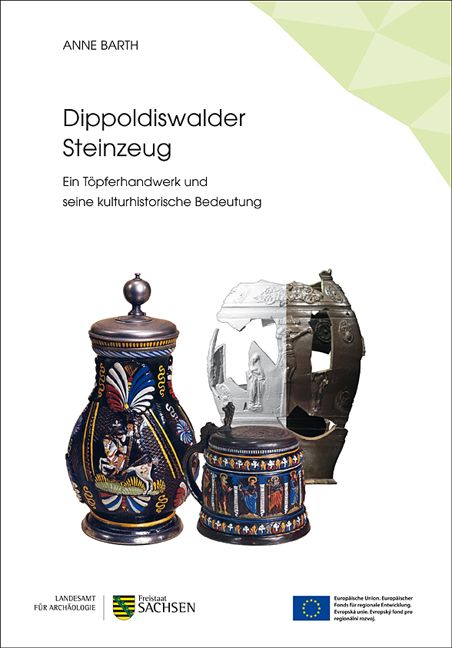
Anne Barth: Dippoldiswalder Steinzeug. Ein Töpferhandwerk und seine kulturhistorische Bedeutung 2018
Landesamt für Archäologie Sachsen (Verlag).
https://journals.ub.uni-heidelberg.de/index.php/mitt-dgamn/article/view/77935


