Talavera Apothecary Jar ca. 1750


18th century Talavera Apothecary Jar and the Miracle of the Sacred Hosts of Alcalá de Henares.
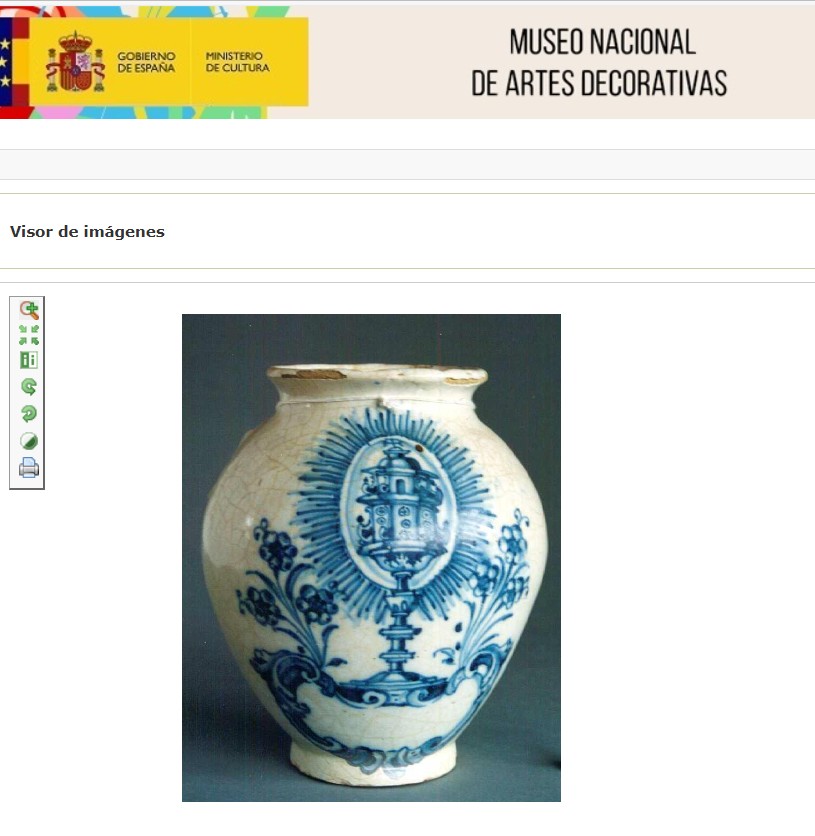
This elegant Talavera faience apothecary jar, dating from approximately 1750-1767, represents a fascinating intersection of ceramic artistry, religious devotion, and historical memory.
Its blue-and-white decoration on a brilliant white glaze, pictures symbols of a remarkable story of one of the most celebrated miraculous events in Spanish Counter-Reformation history:
The Miracle of the Sacred Hosts of Alcalá de Henares
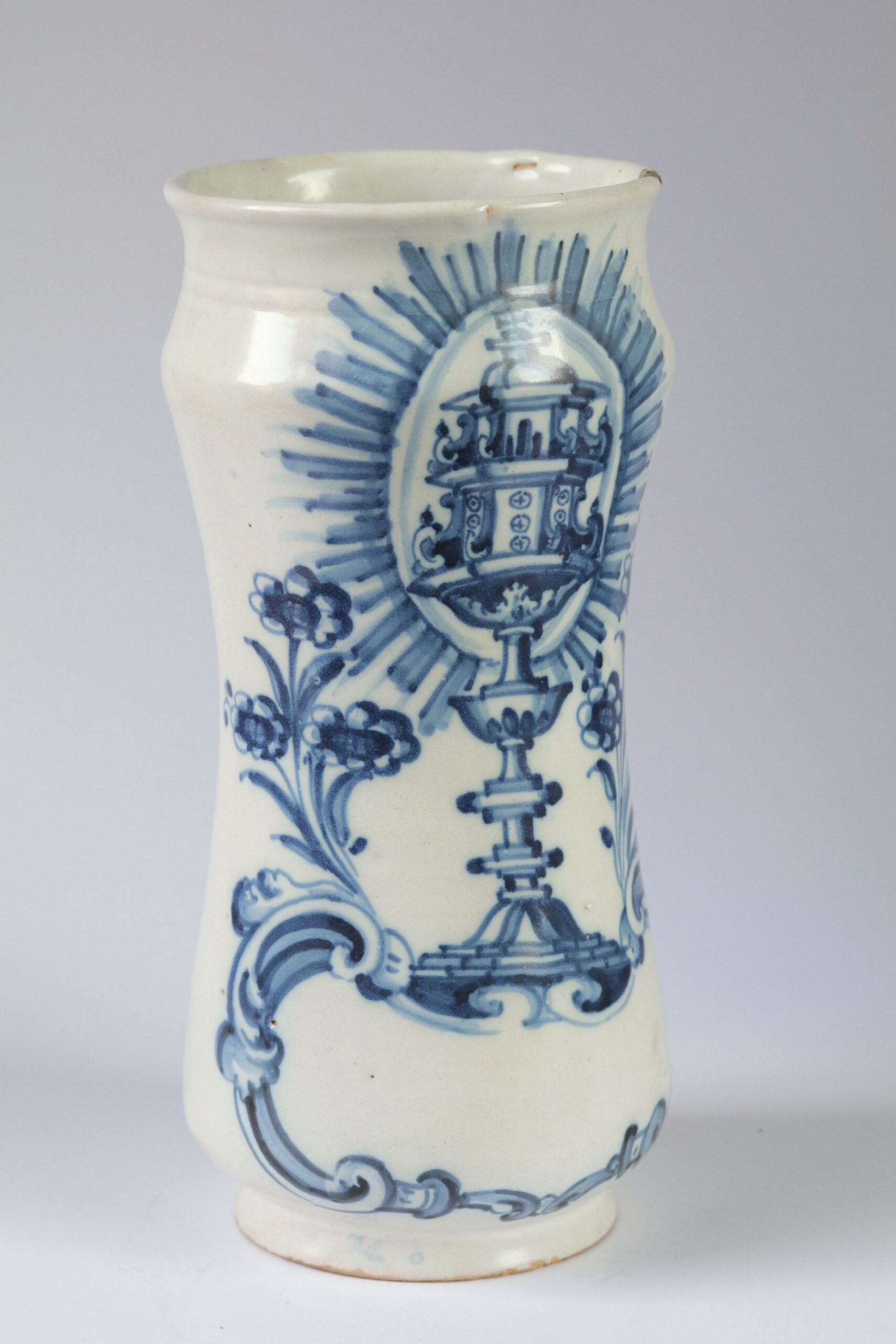
The Iconography: A Lost Monstrance
The central motif on this jar depicts a processional monstrance with distinctive features: a bulbous foot, a molded stem, and most remarkably, an elaborate reliquary chamber surrounded by radiating rays. This is no ordinary monstrance but rather a specific representation of the celebrated custodia-reliquary of the Sacred Hosts that belonged to the Jesuit College (Colegio Máximo) of Alcalá de Henares.
The monstrance itself, commissioned in 1622 by Don Agustín Spínola—son of the famous General Ambrogio Spínola, conqueror of Breda—was an elaborate silver work featuring an octagonal prismatic body housed within a baldachin of eight smooth columns with Tuscan capitals. It was decorated with bells, enameled oval mirrors, and incorporated rock crystal panels riveted with silver nails. This magnificent liturgical object was tragically destroyed at the outbreak of the Spanish Civil War in 1936.
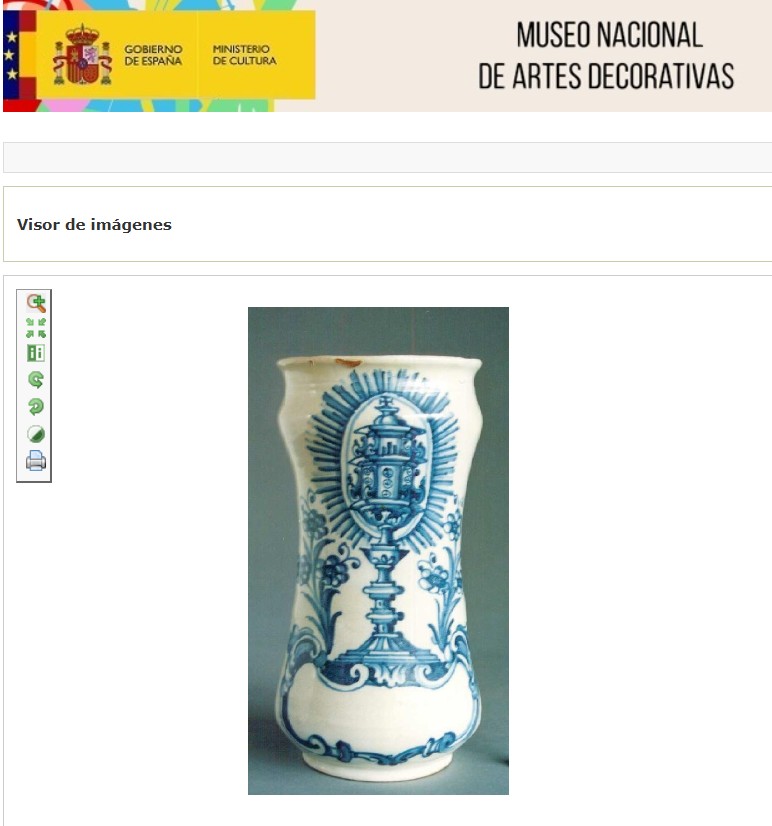
This article is based on the in depth description of the reference objects in the Museo Nacional de Artes Decorativas (inventory number CE25580 – CE25582). You have access to the PDF in Spanish with the following link:
Talavera Monastic Pharmacy Ware and the Jesuit College of Alcalá de Henares
This jar belongs to what scholars classify as the „monastic“ or „heraldic“ series of Talavera ceramics. These pieces, decorated primarily with coats of arms and emblems of convents, monasteries, or religious orders, were mainly destined for institutional apothecaries. During the 18th century, religious establishments maintained sophisticated pharmacies, requiring substantial quantities of storage vessels for medicinal preparations, herbs, and compounds.
The decorative scheme reflects the transition in taste that occurred with the arrival of the Bourbon dynasty in Spain. Earlier Habsburg-era pieces featured coats of arms surrounded by geometric „cutout“ motifs with scrolls at the bottom, curls at the top, and quadrangular protrusions in the center. By the mid-18th century, as seen in this jar, these had been replaced by more naturalistic plant elements and rocaille-inspired cartouches, echoing the Baroque architectural decorations popular throughout Europe at the time.
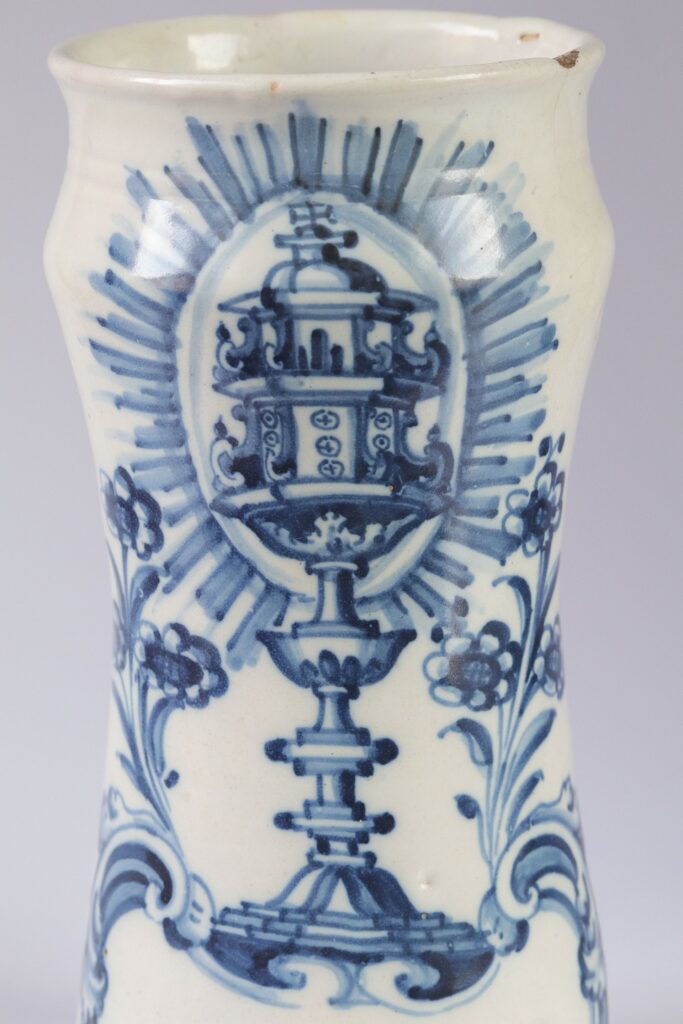

The Miracle of the Sacred Hosts of Alcalá de Henares
The monstrance depicted on this jar housed twenty-four consecrated hosts connected to an extraordinary event that captivated the Spanish Catholic imagination for centuries. In May 1597, a remorseful thief arrived at the Jesuit church in Alcalá (now Santa María) and confessed to Father Juan Juárez that he had stolen sacred vessels containing consecrated hosts from a church. He handed over twenty-four hosts wrapped in cloth.
The Jesuit Superior, Father Gabriel Vázquez, aware that poisoned hosts had been used to murder priests in Segovia, Murcia, and elsewhere, decided not to consume them. Instead, they were placed in a small silver box with instructions to destroy them once they decomposed. However, after eleven years, the hosts remained inexplicably fresh.
The University of Alcalá accepted this evidence, and on July 16, 1619, the Vicar General of Alcalá declared it a public miracle, celebrated with a solemn procession through the city streets. This feast was subsequently celebrated annually on the fifth Sunday after Easter, becoming a defining element of Alcalá’s religious identity.
When Charles III expelled the Jesuits from Spain in 1767, the Sacred Hosts were transferred to Alcalá’s Magistral Church in a solemn procession on April 20, 1777. In the 19th century, a ring gifted by Joseph Bonaparte was added to the monstrance. The entire reliquary disappeared in 1936, almost certainly destroyed in the chaos of the Civil War’s opening days—a loss that severed a nearly 340-year connection between object, miracle, and community.
The potters of Talavera in the middle of 18th century

The fourth Ordinance of the Potters of Talavera (1751) distinguished between simpler heraldic work entrusted to „colorist draftsmen“ and more complex „foliage shields“ reserved for master-level artists. This jar, with its sophisticated rendering of the monstrance and well-balanced ornamental surround, likely represents the work of skilled specialists.
White Series Excellence
These objects also exemplify the celebrated „white series“ of Talavera ceramics, renowned for the quality and brilliance of their white glaze. Associated with hygiene and purity—essential values for pharmacy ware—these pieces achieved enormous production volumes and geographical distribution throughout Spain and Portugal from the 16th through early 19th centuries.
Paradoxically, despite their commercial success and widespread use, white series pieces survive in far lower proportions than more decorative ceramics. Their functional, everyday nature meant they were used hard and valued less as collectibles, leading to higher attrition rates. This makes surviving examples like this jar particularly precious as material witnesses to daily life in religious institutions.
For collectors and historians of European ceramics, such pieces remind us that even utilitarian objects can carry profound cultural meanings, serving as three-dimensional archives of faith, art, and community identity.
Barock Rocks – Get your faience collection out of the showcase
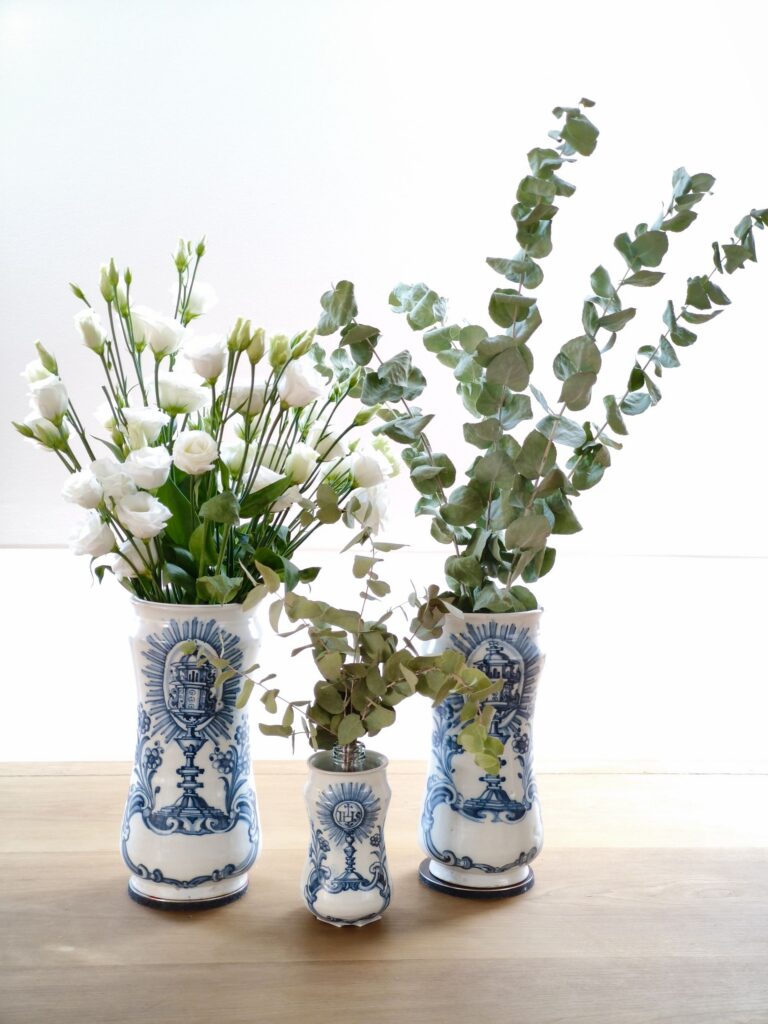
Baroque Rocks
Get your faience collection out of the showcase!
Be inspired for an individual „interior styling“ with original objects from past centuries.
To preserve the precious objects, you can use matching glass or plastic inlays so you can decorate with real flowers and put them into water.
Museo Nacional de Artes Decorativas –
Object Details of reference objects:
Preserved in the Museo Nacional de Artes Decorativas (inventory number CE25580 – CE25582)
- Type: Apothecary jar (albarelo)
- Origin: Talavera de la Reina, Spain
- Date: ca. 1750-1770
- Technique: Tin-glazed earthenware (faience), blue on white
- Collection: Museo Nacional de Artes Decorativas, Madrid
- Inventory: CE25580 CE25581 CE25582

Literature Reference of the Museo Nacional de Artes Decorativas :
BIBLIOGRAFÍA:
AZAÑA, Esteban: Historia de Alcalá de Henares: Antigua Compluto,
adicionada con una reseña histórico-geográfica de los pueblos de su
partido judicial. Imprenta de F. García, 1882. Edición facsimilar.
Alcalá de Henares, 2005.
GÓNZALEZ ZAMORA, César: Talaveras. Antiqvaria, Madrid, 2004.
(11.315).
MUÑOZ SANTOS, Mª Evangelina: Las artes decorativas en Alcalá de
Henares: la platería y rejería en la Capilla de San Ildefonso y
Magistral SS. XVI-XVII-XVIII. Alcalá de Henanres, Universidad de
Alcalá, 2000 (10.192).
REYMUNDO TORNERO, Anselmo: Datos históricos de la ciudad de
Alcalá de Henares. Alcalá de Henares, 1950.
„Dibujos de arquitectura y ornamentación de la Biblioteca Nacional
del siglo XVIII“. Textos introductorios de Delfín Rodriguez Ruiz.
Madrid, Biblioteca Nacional de España, Fundación Banco Santander,
Fundación Arquietctura, COAM, 2009 (12.915).
„Lozas y azulejos de la colección Carranza“. 2 Vol. Alfonso
Pleguezuelo (coord.). Junta de Comunidades de Castilla-La Mancha.
Consejería de Educación y Cultura. Toledo, 2002. (11.723)
„Tierras de Alcalá. El valle del Henares (I)“. DOCUMADRID.
Comunidad de Madrid, Consejería de Educación, Secretaría General
Técnica, 2001.


