Hausmaler Faience and „The Tulip Fever“


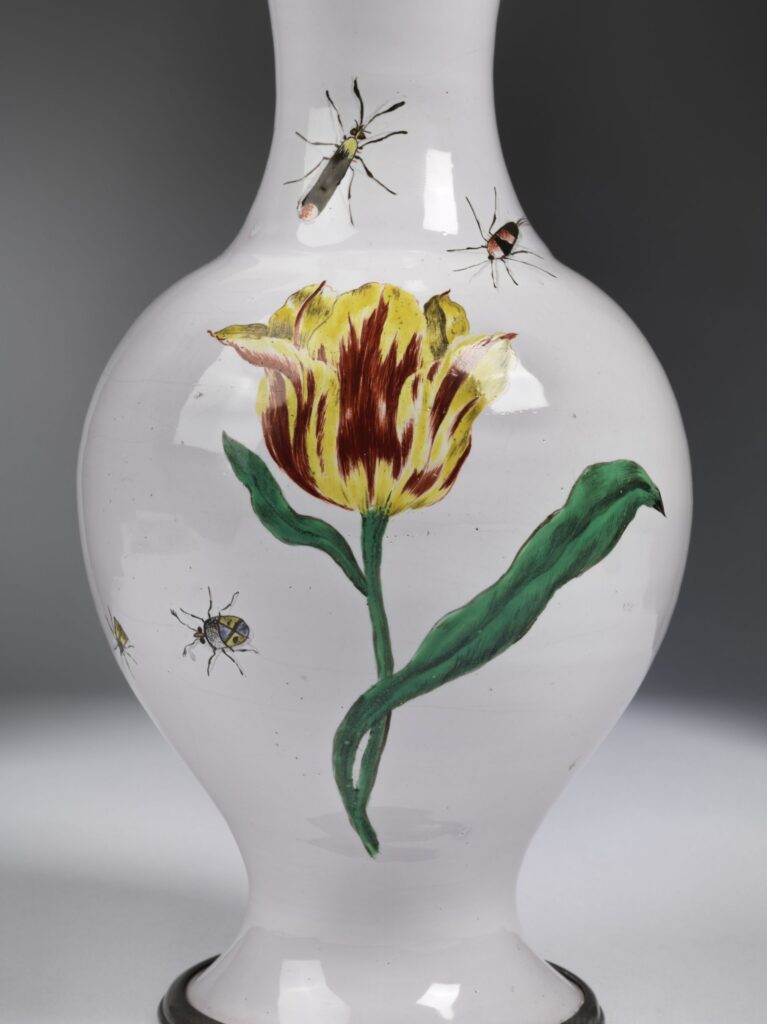
A Künersberg Faience Jug painted in Augsburg ca. 1750
German Künersberg faience jug circa 1750, polychrome Tulip and Insects decoration by an Augsburg Hausmaler
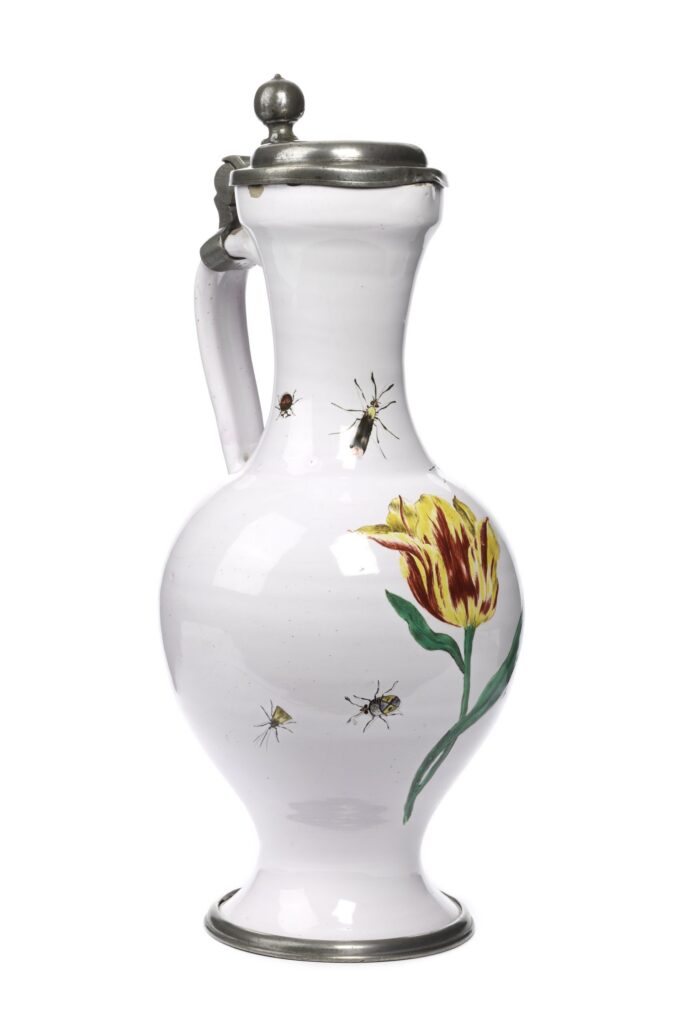
HAUSMALEREI | STUDIO PAINTING
After the decline of the Nuremberg HAUSMALER workshops in the 1720s began the peak period of the Augsburg HAUSMALER.
Hausmaler painted the undecorated pieces, which they acquired from factories in Delft, Hanau, Frankfurt and later as well whiteware from Kuenersberg in their own particular technique of schwarzlot or colored enamel. Two groups of craftsmen possessed the required expertise to decorate unpainted faience pieces and fire them in the little muffle-kilns in their workshops. Firstly, the glass painters, who simply applied to faience decoration the technique of muffle-fired painting already known to them from their own craft and, as was usual in monumental glass painting, they preferred schwarzlot; secondly, the goldsmiths, who used their skills in enameling and put the fusible bigments of various colors on the admirably suited faience. As the Hausmaler had their „workshops“ on their own premises they did not have to follow regulations of the guilds and therefore free to expres their own style of craftsmanship. After 1720, Nuremberg had to yield pride of place in the field of this type of STUDIO painting to Augsburg.
(S. 18 f. Bosch, H. (1983). Deutsche Fayencekrüge des 17. und 18. Jahrhunderts: Sammlungen Hans Cohn, Los Angeles, Siegfried Kramarsky, New York. P. von Zabern.)
Further readings on Hausmaler in this article of collectors weekly : https://www.collectorsweekly.com/articles/hausmaler-decoration-on-fayence-and-porcelain/
This article discusses hausmaler, individual German painters who worked on fayence or porcelain, noting some specific artists and their designs. It originally appeared in the November 1945 issue of American Collector magazine, a publication which ran from 1933-1948 and served antiques collectors and dealers.
Inspiration
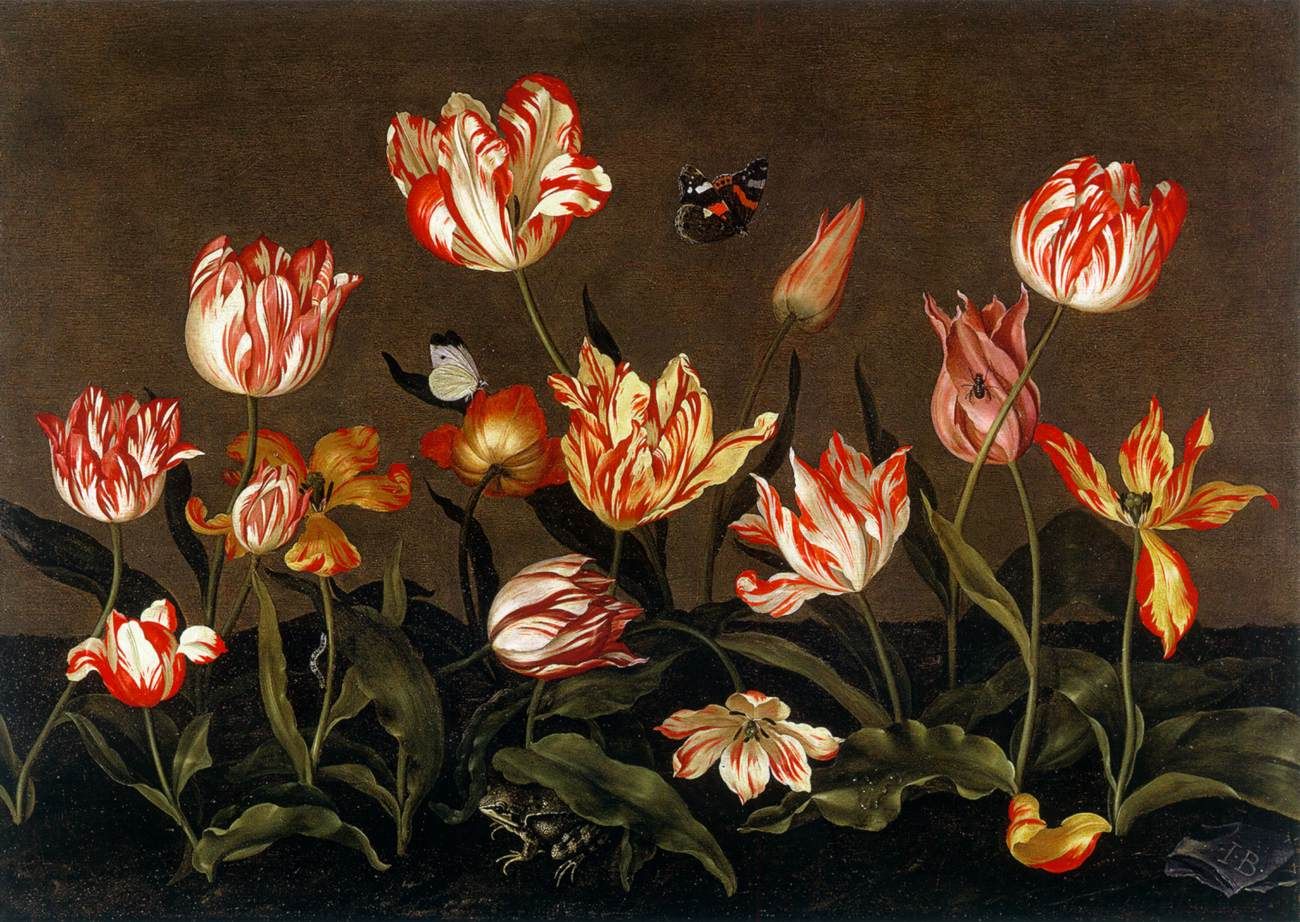
BOSSCHAERT, Johannes Dutch painter (b. ca. 1607, Middelburg, d. ca. 1628, Dordrecht) „Still Life with Tulips“
copyright: National Museum in Stockholm
It was Jacob Marrel (1613–1681)— tulip book draughtsman, Frankfurt flower painter, and stepfather and teacher of Maria Sibylla Merian (* 2. April 1647 in Frankfurt am Main; † 13. Januar 1717 in Amsterdam) — who translated the Flemish and Dutch tradition of the flower-with-insect directly into the German workshop vocabulary that Augsburg Hausmaler would inherit a generation later.
Further readings at the Rijksmuseum Amsterdam: https://www.rijksmuseum.nl/en/collection/object/Still-Life-with-a-Vase-of-Flowers-and-a-Dead-Frog–1d9349268559bf1a7f761eb6397f0922
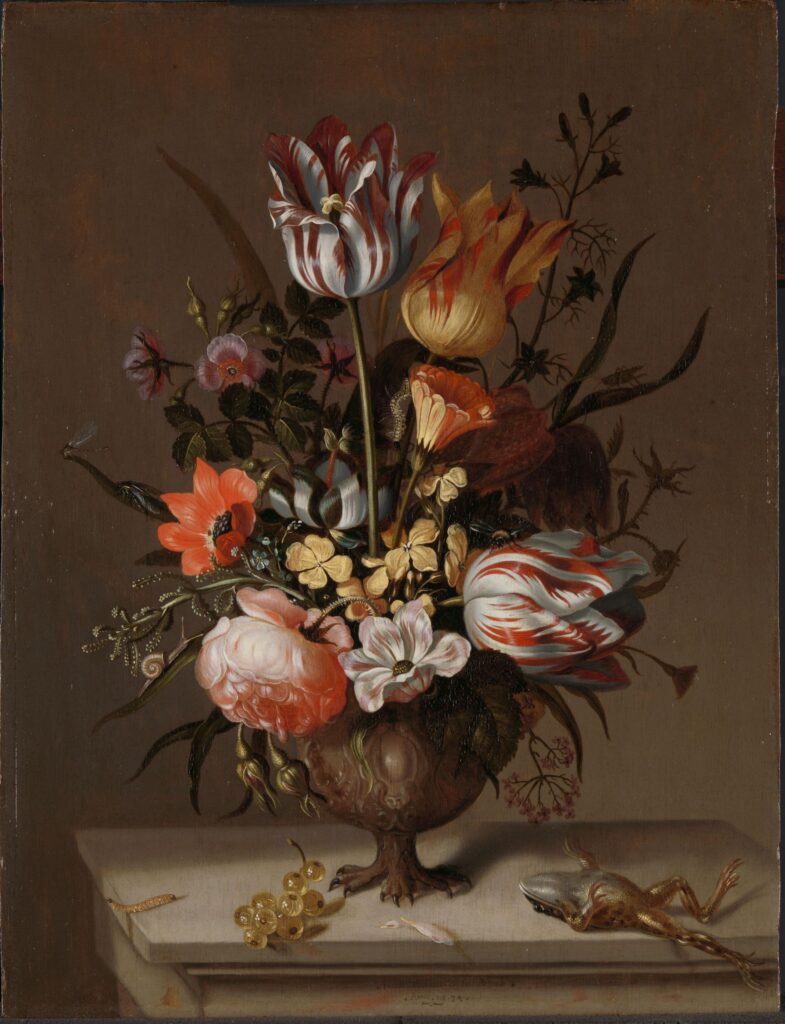
Still Life with a Vase of Flowers and a Dead Frog
Jacob Marrel (mentioned on object), 1634
Jacob Marrel’s specialized in ‘portraits’ of tulips in bloom. Tulip bulbs were collected fanatically in 17th-century Holland, and astronomical prices were sometimes paid for a single bulb. In this painting as well, tulips play a leading role. The whimsically shaped red-and-white and red-and-yellow striped tulips were especially prized. Although nature creates them, it also lets them wither and die – just like the dead frog at the right. https://id.rijksmuseum.nl/200109450
Holland and the Tulip Fever
The original Dutch term was tulpenwoede — literally „tulip fury“ or „tulip rage“
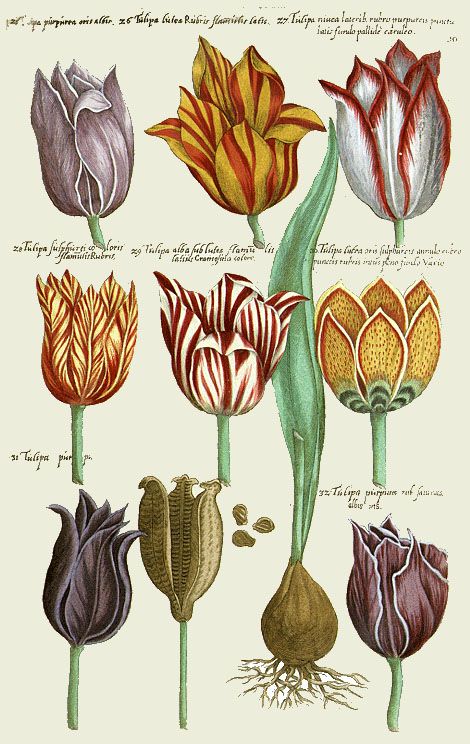
Florilegium amplissimum et selectissimum ist ein zweiteiliges Florilegium von Emanuel Sweerts, das erstmals 1612 in Frankfurt am Main veröffentlicht wurde. Auf 110 Tafeln sind 573 Pflanzen dargestellt. Es wurde bis 1654 mehrfach in fast unveränderter Form neu herausgegeben
Emanuel Sweerts: Florilegium. 1647
https://de.wikipedia.org/wiki/Florilegium_amplissimum_et_selectissimum
The tulip’s real breakthrough came in the 1590s when Dutch botanist Carolus Clusius summed up his knowledge of the subject at the University of Leiden, after meeting Ambassador Busbequius and realizing that the Dutch cultivation conditions suited the exotic flower well. The tulip mania which swept Holland earlier in the seventeenth century produced Dutch treasures like Semper Augustus or Viceroy. Around 1630 there were more than 140 different tulip species registered in the Netherlands. Single and multicolored tulips with streaks, stretches and flaming leaves were divided into different families.
Read more in this article by the Amsterdam Tulip Museum: https://amsterdamtulipmuseum.com/pages/tulip-history-tulipmania-netherlands
Museum Reference Hetjens Museum Düsseldorf
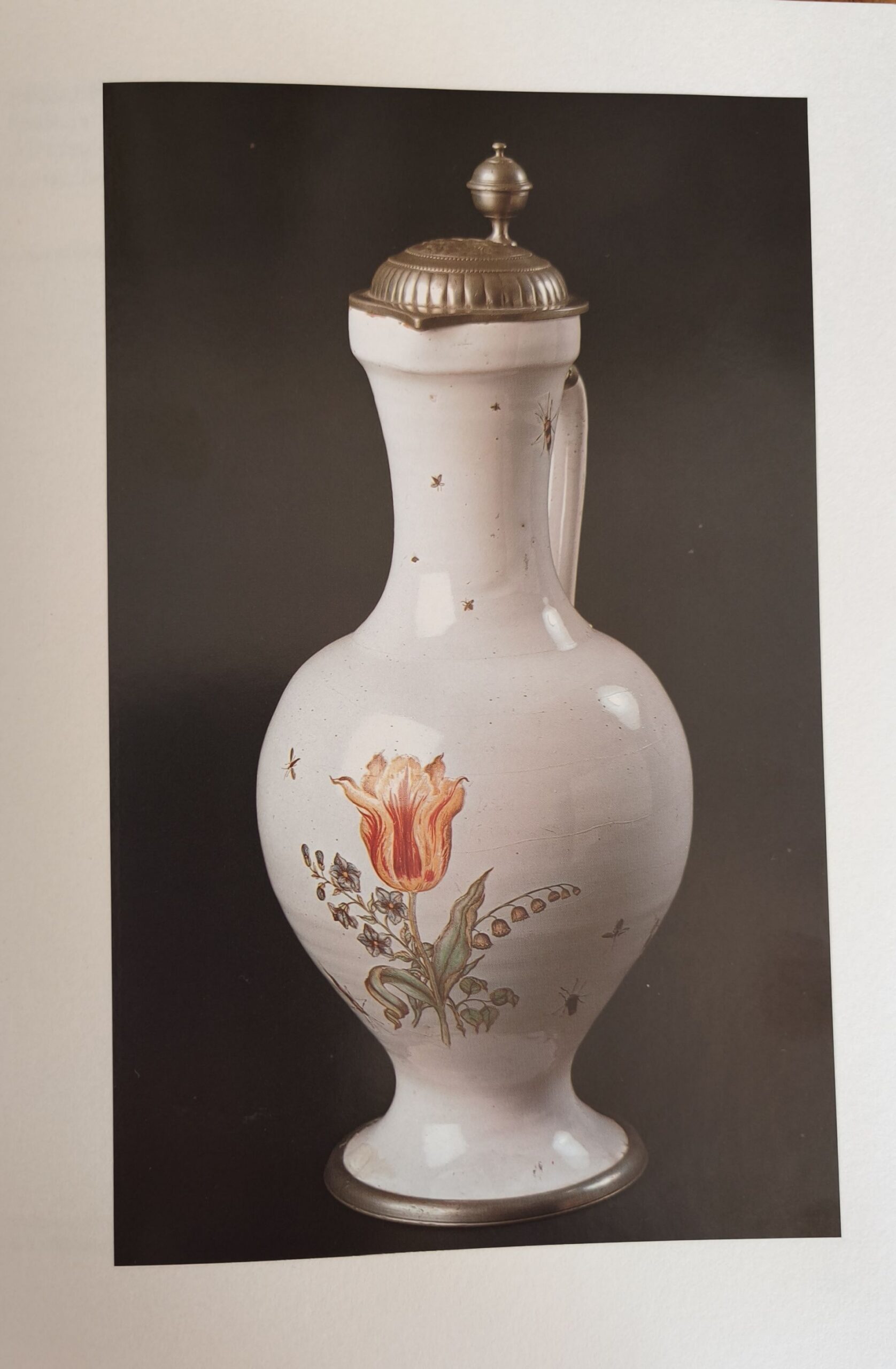
Enghalskrug Kuenersberg 1745 – 1760
H. 32 cm.
Abb. 79 / S. 206
Klein, Adalbert, and Carlfred Halbach. Keramik aus 5000 Jahren: 107 Meisterwerke aus dem Hetjens-Museum
Inventar Nr. R 54
Literature
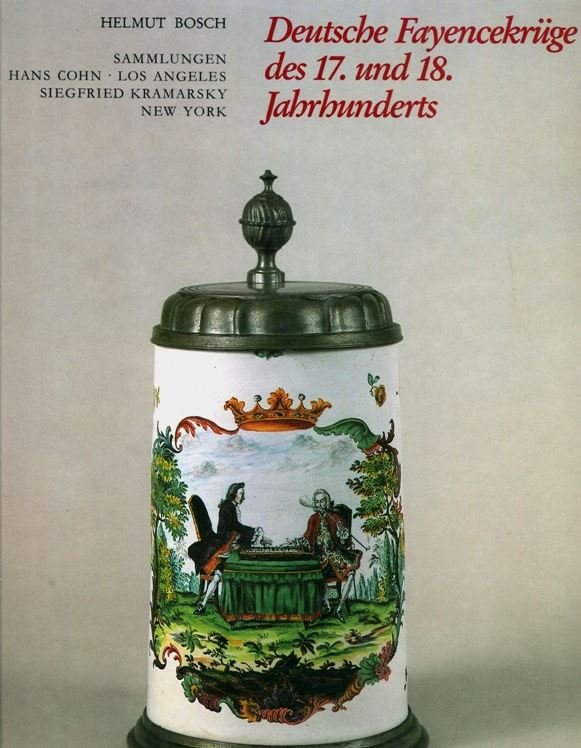
English and German Edition
Bosch, Helmut: Deutsche Fayencekrüge des 17. und 18. Jahrhunderts. Sammlungen Hans Cohn, Los Angeles. Siegfried Kramarsky, New York. Mainz: Von Zabern 1983.
Klein, Adalbert, and Carlfred Halbach. Keramik aus 5000 Jahren: 107 Meisterwerke aus dem Hetjens-Museum, Deutsches Keramik-Museum, Düsseldorf. Schwann, 1979.


